Hoi An Ancient Town in one day on foot: a walking itinerary
This Hoi An one day itinerary keeps you inside the Ancient Town on foot from 8:00 to dark. You cross the Japanese Covered Bridge, walk through two merchant houses, stand in the courtyard of the Fujian Assembly Hall, see the town museum, watch a Japanese tea ceremony and finish at the night market. All seven stops sit within a few streets of each other, so you need no bike or taxi.
The plan also uses the old town ticket in full. The top ticket covers five entries, and this day spends exactly five of them, plus the tea ceremony that comes with it.
I built the day in Passage AI for a Thursday in November, added each stop, set the times and ran the Need tickets? scan. Prices, ticket rules and closing days are checked against the Hoi An World Heritage site, run by the Hoi An World Cultural Heritage Conservation Centre, and linked below.
Last checked: Nov 2026. The official pages are mostly in Vietnamese and some are a few years old. Open the linked page or ask at a ticket booth before you go.
The Hoi An one day itinerary at a glance
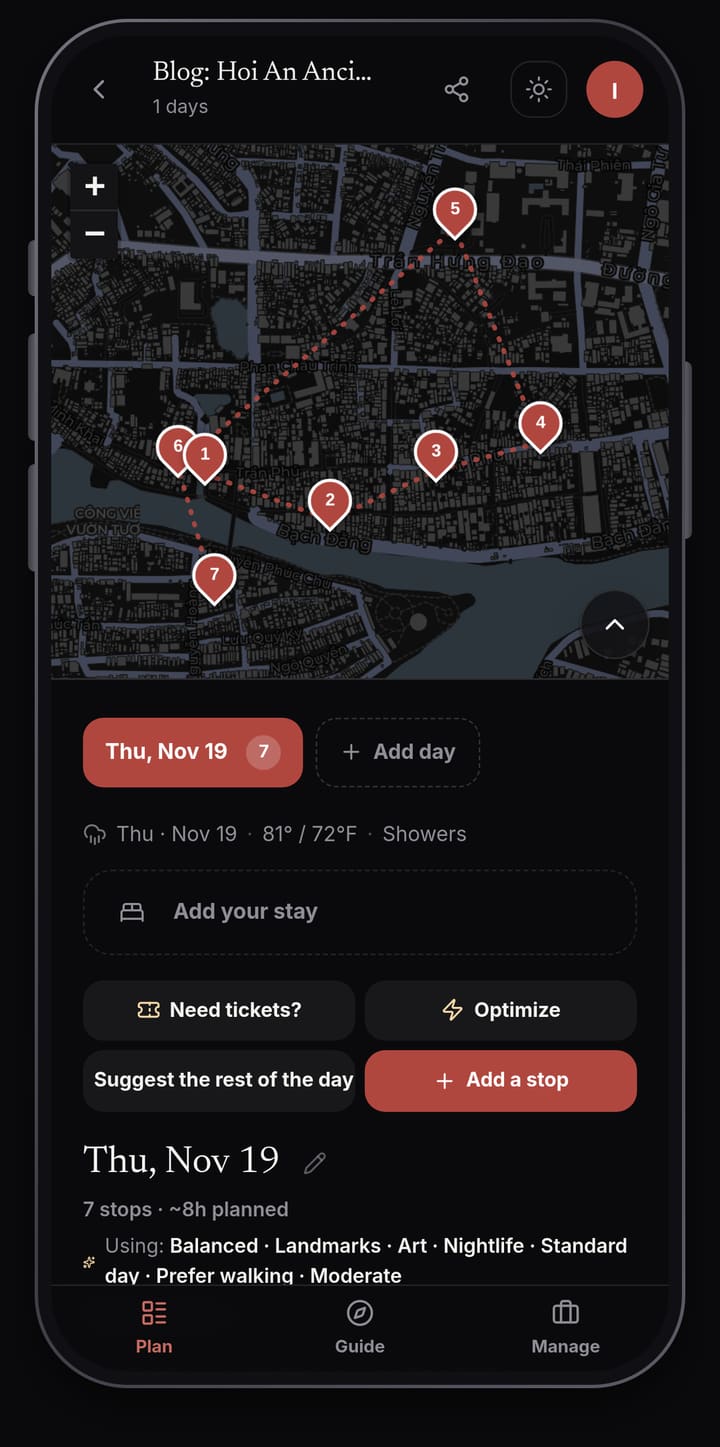
The table shows the day in order, with the time I set for each stop and the walk to the next one.
| # | Stop | Time | Walk to next stop |
|---|---|---|---|
| 1 | Japanese Covered Bridge (Chua Cau) | 8:00 AM | 2 min |
| 2 | Tan Ky Old House | 8:45 AM | 2 min |
| 3 | Quan Thang Old House | 9:30 AM | 2 min |
| 4 | Fujian Assembly Hall | 10:15 AM | 4 min |
| 5 | Hoi An History and Culture Museum | 11:15 AM | 7 min |
| 6 | Japanese Culture Exhibition House (tea ceremony) | 4:15 PM | 2 min |
| 7 | Hoi An Night Market | 5:30 PM |
That's 19 minutes of walking between stops for the whole day. Walk times in Passage AI are straight-line estimates between stops; tap Directions and your phone's maps app opens with the street route.
Stop by stop
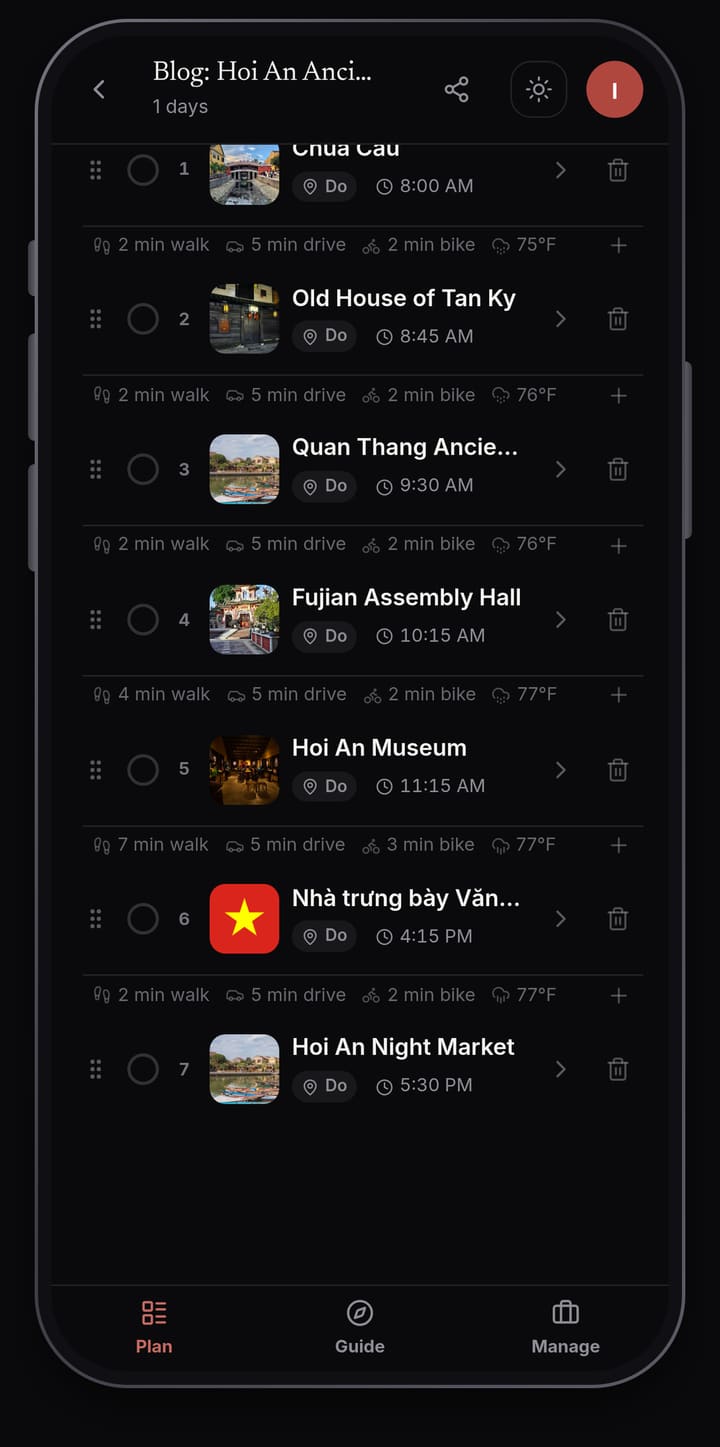
1. Japanese Covered Bridge (Chua Cau), 8:00
Start at the west end of Tran Phu Street, where it meets Nguyen Thi Minh Khai. Japanese merchants built the bridge in the early 17th century, and a small pagoda was added on its north side in 1653, which is why locals call it Chua Cau, the "bridge pagoda". It's about 18 metres long under a tiled roof. Local legend says the pagoda pins down a monster whose thrashing tail causes earthquakes. (official page)
The bridge reopened on 3 August 2024 after almost two years of restoration. (Vietnamese government news portal)
The heritage centre asks visitors to buy a ticket before entering the old town, so stop at a booth first. Going inside the bridge uses one entry on the ticket. The heritage centre's own tips suggest coming early in the morning, and from 9:00 the old town lanes close to motor traffic.
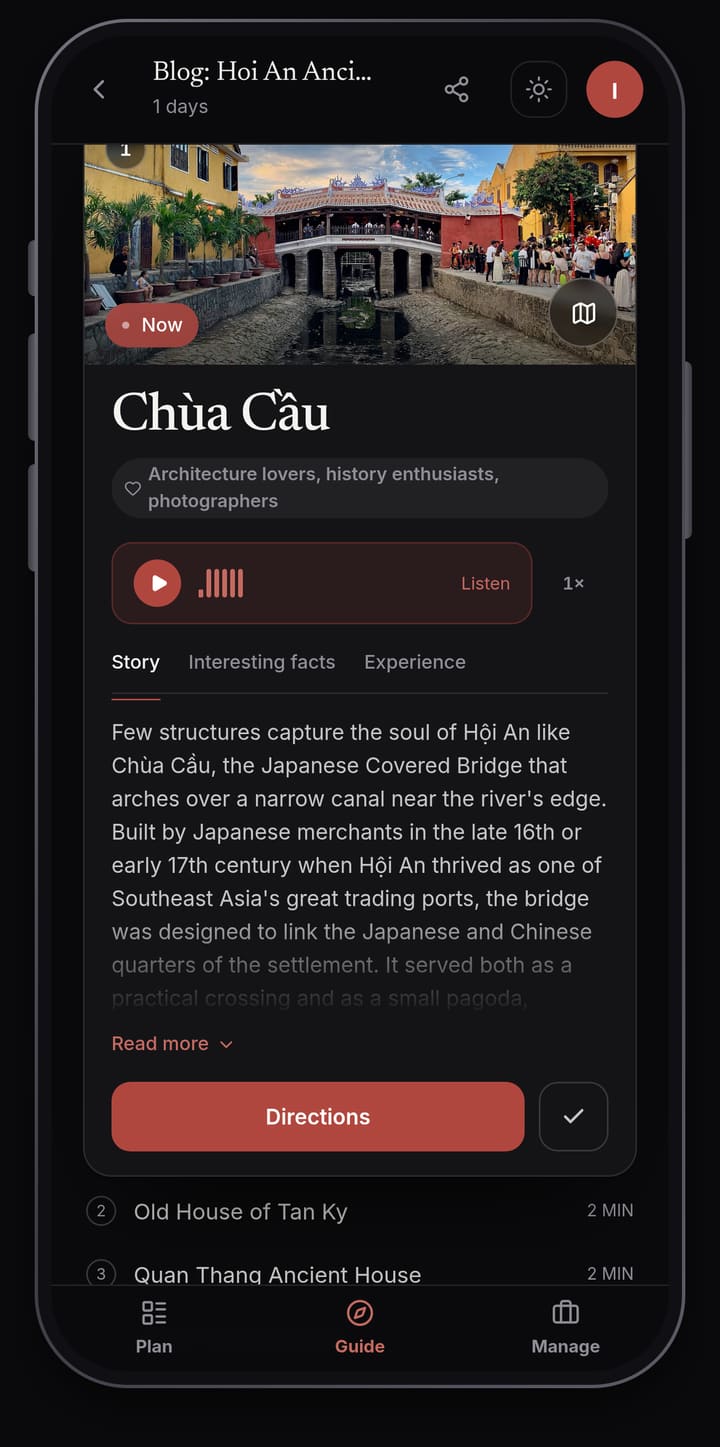
When you reach a stop, Passage AI's Guide opens a card like this with the story of the place. Tap Listen to hear it read aloud.
2. Tan Ky Old House, 8:45
A merchant family's house at 101 Nguyen Thai Hoc, a short walk east of the bridge. It's built as a run of connected sections, one behind the other, with carved roof beams, and the official page quotes a sixth-generation descendant of the family. (official page)
3. Quan Thang Old House, 9:30
More than 150 years old and one of the oldest houses in the old town, Quan Thang runs through the block from Tran Phu to Nguyen Thai Hoc. Craftsmen from the Kim Bong carpentry village did the woodwork. Look for the small open-air courtyard in the middle, with walls decorated in Chinese ceramics. (official page)
4. Fujian Assembly Hall (Phuc Kien), 10:15
A Chinese community hall at 46 Tran Phu. Merchants from Fujian built it in 1697 to worship Thien Hau, the goddess who protects sailors and traders at sea, and it was listed as a national historic site in 1990. Inside are a front hall, the main hall, a rear sanctuary and east and west wings. (Hoi An heritage centre page)
5. Hoi An History and Culture Museum, 11:15
Listed as Hoi An Museum in the app, at 10B Tran Hung Dao, a few streets north of Tran Phu. The museum opened in 1989 and shows more than 212 objects in ceramic, bronze, iron, paper and wood, from the Sa Huynh culture through the Champa period to the trading-port centuries. Many were found in the riverbed and the sea off Hoi An. It's open every day except the 25th of each month. (official page)
Lunch and a long break, 12:00 to 4:00 PM
The plan leaves the middle of the day open. The heritage centre's travel page names the town's dishes: cao lau noodles, mi Quang, Hoi An chicken rice, and banh bao banh vac dumplings. (official page) Eat, go back to your room or sit out the heat in a cafe. The same page lists August to December as the rainy season, so in autumn carry a rain layer.
6. Japanese Culture Exhibition House and tea ceremony, 4:15 PM
Back at the west end, at 06 Nguyen Thi Minh Khai, a few steps from the bridge. The house puts on a Japanese tea ceremony at 9:30 and 16:30 every day, and it's one of the extras your old town ticket includes on top of the five entries. Arrive by 4:15 for the 4:30 session. (official page)
7. Hoi An Night Market, 5:30 PM
Cross the river to Nguyen Hoang Street in An Hoi for the night market. The official site gives no hours for the market, so check before you go. Back in the old town, the "night street" programme runs folk games such as bai choi, folk-song classes and street music, and ticket holders can join in. The lanes stay pedestrian-only until 21:00 in winter and 21:30 in summer. (official page)
The Hoi An ancient town ticket: what it covers
You buy one ticket for the old town, with a box for each site you visit. The official visitor information page (posted May 2023, the newest ticket page on the site) lists two tickets:
| Ticket | What it covers |
|---|---|
| 120,000 VND | Old town scenery, the Japanese Covered Bridge or Quan Cong Temple, one museum of your choice, three more sites of your choice |
| 80,000 VND | Old town scenery, the Japanese Covered Bridge or Quan Cong Temple, two more sites of your choice |
The earlier 2020 version of the page lists the 120,000 VND ticket for foreign visitors and the 80,000 VND one for Vietnamese visitors. It also says you buy the ticket once for your whole stay, children under 16 go free, and students and visitors over 60 pay half. (2020 page) Those rules are older than the 2023 page, so check at the booth before you go.
A few more rules from the 2023 page:
- Keep the stub after you've used every entry. You still need it to walk in and out of the old town.
- Groups buying 8 tickets or more get a free guide.
- The tea ceremony at the Japanese Culture Exhibition House and the evening folk-game programme come with the ticket, outside the five entries.
The day above spends the 120,000 VND ticket exactly: the bridge, the museum, then Tan Ky, Quan Thang and the Fujian hall as the three choices. Tickets are sold at the booths around the old town, and the heritage centre's hotline is +84 843 42 8888.
What Need tickets? flagged
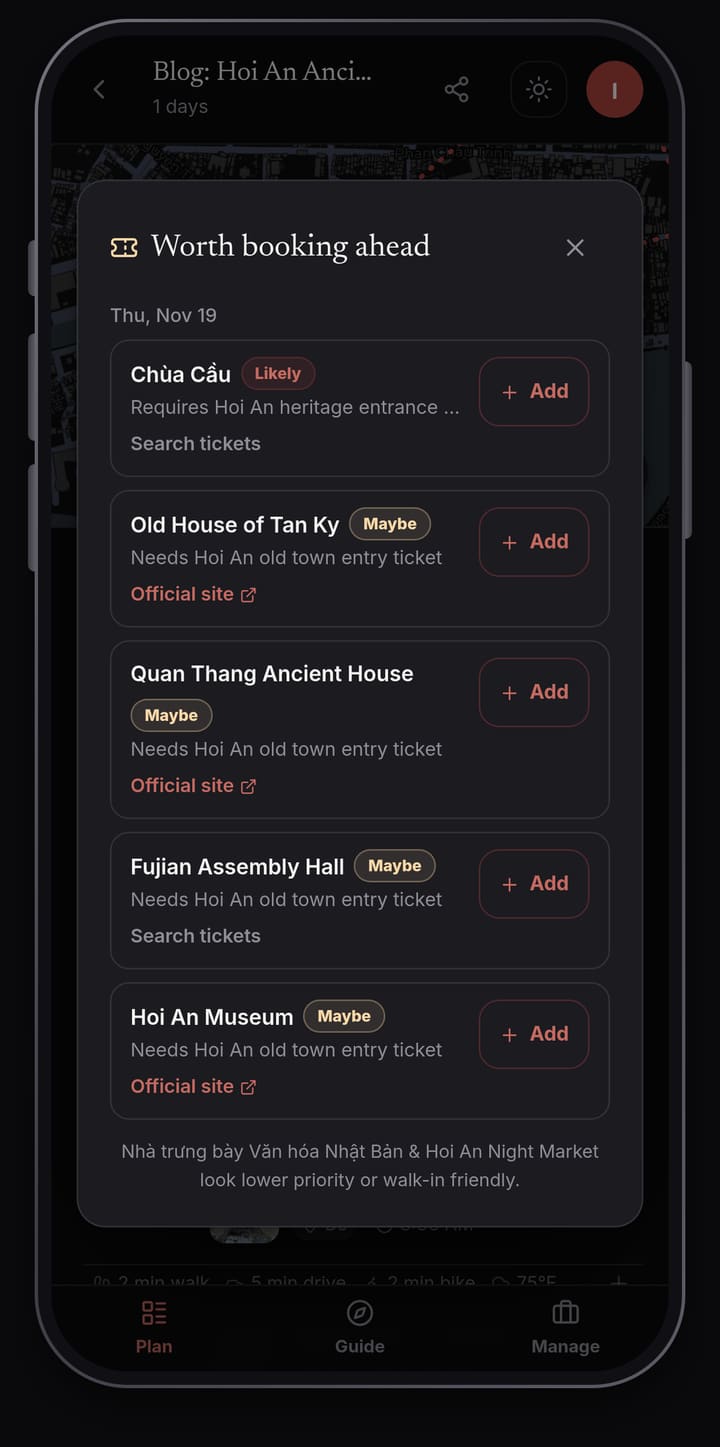
Need tickets? scans the whole trip and marks the stops that usually need a ticket. Here's how its list lines up with the official page:
| Stop | Need tickets? | Official site (checked Nov 2026) |
|---|---|---|
| Japanese Covered Bridge | Likely | Uses the bridge-or-Quan-Cong entry on the old town ticket |
| Tan Ky Old House | Maybe | One of your three site choices |
| Quan Thang Old House | Maybe | One of your three site choices |
| Fujian Assembly Hall | Maybe | One of your three site choices |
| Hoi An Museum | Maybe | The ticket's museum entry |
It put the Japanese Culture Exhibition House and the night market under lower priority or walk-in. The tea ceremony comes with the old town ticket, and the official ticket page doesn't list the night market. One 120,000 VND ticket, bought at a booth in the morning, covers every ticketed stop on the day.
Two good orders for the morning
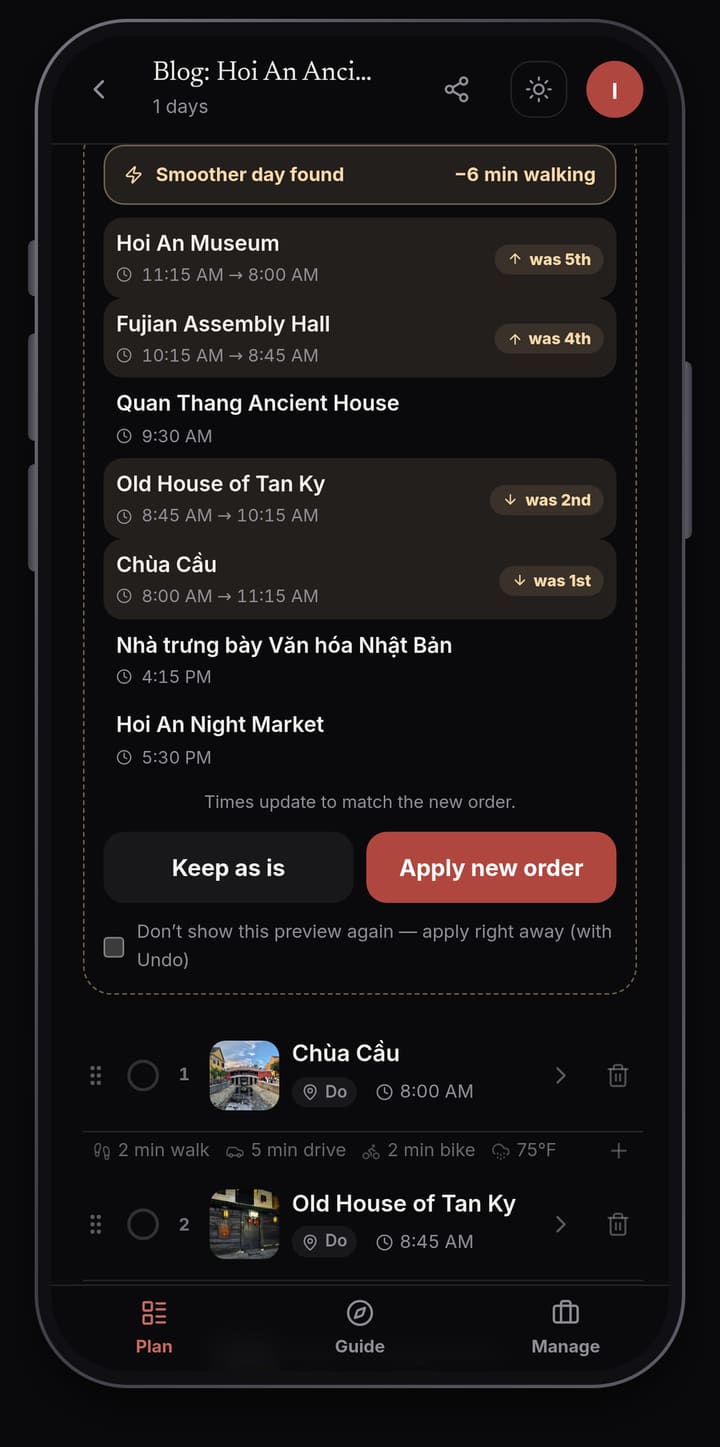
Optimize found an order with 6 minutes less walking: start at the museum at 8:00, work back west through the Fujian hall and the two houses, and reach the bridge at 11:15. Both orders work. I kept the bridge first because the heritage centre's own tips recommend seeing the old town early in the morning. Tap Apply if you'd rather take the shorter walk.
Optimize shows the preview with each stop's old position before anything changes, and nothing saves until you press Apply.
What to skip or swap
- Quan Cong Temple instead of the bridge entry. The ticket covers one of the two. The temple at 24 Tran Phu dates from the mid-17th century and honours Quan Vu (Guan Yu), the Three Kingdoms general, with life-size horse statues in the main hall. (official page) It's on the same street as the Fujian hall, so it slots in after it.
- Rain all day? Most of the morning is spent under a roof, and no walk between stops is longer than 7 minutes.
- On the 25th of the month, the museum is closed. Spend the ticket's museum entry at another museum instead: the 2020 ticket page also lists the Museum of Trade Ceramics and the Museum of Folk Culture. Check their opening days before you go.
- Want the craft villages? Thanh Ha pottery village sits outside the old town and has its own 35,000 VND ticket (2020 page). You need a bike or taxi, so give it its own half day, and check the price before you go.
FAQ
Is one day enough for Hoi An Ancient Town?
For the old town on foot, yes. The heritage sites sit within a few streets of each other, and this day fits five ticketed sites, a tea ceremony and the night market with a long midday break. The beaches and the craft villages need a bike or taxi, so give them a second day.
How much is the Hoi An ancient town ticket?
The official site lists 120,000 VND for old town scenery plus five entries (the bridge or Quan Cong Temple, a museum and three more sites) and 80,000 VND for scenery plus three entries. Its 2020 page lists the 120,000 VND ticket for foreign visitors. The newest ticket page dates from May 2023, so confirm the price at the booth.
Can I go inside the Japanese Covered Bridge?
Yes. It reopened in August 2024 after restoration, and entry uses one box on the old town ticket. The same box can go to Quan Cong Temple instead, so pick one.
Which day should I avoid?
The 25th of any month, when the Hoi An History and Culture Museum closes. Otherwise the museum opens every day.
How much walking is this itinerary?
About 19 minutes between stops, measured in straight lines in Passage AI, and every leg is 7 minutes or less. Most of the day goes on the sites, lunch and the break.
Can I use Passage AI on Android?
An Android app is coming soon; on Android today you can plan in the browser at mypassage.ai. Saved plans open offline.
How this was made: planned in Passage AI on 11 November 2026, facts checked against the Hoi An World Heritage site of the Hoi An World Cultural Heritage Conservation Centre, the Hoi An heritage centre's site and the Vietnamese government news portal, written by Edward.
Cover photo: Chainwit. on Wikimedia Commons (CC BY 4.0, cropped)
