How many sights can you really see in a day on foot?
How many attractions can you see in one day on foot? In a big city, plan on five to seven sights, plus two or three meals, between about 9:00 and 20:00. Two big museums in one day bring it down to about five. In a small town where the sights sit a block apart, eight is possible. Walking between stops is almost never the limit. Across six one-day city plans I built in Passage AI, it came to somewhere between 20 and 90 minutes for the whole day. The hours went to time inside, lines, ticket slots and lunch.
Last checked: Oct 2026. Opening hours change, so check each venue's official site before you go.
The short answer: how many attractions can you see in one day
Start by counting stops. A walking day has three kinds:
- Anchors. A big museum, a palace, a tower with a timed ride. Each one takes one to three hours, and you get one or two a day.
- Short stops. A church, a square, a bridge, a viewpoint, a market. Fifteen to forty-five minutes each.
- Meals and breaks. Breakfast or coffee, lunch, dinner, maybe a drink. These are fixed in time, and they take more of the day than people plan for.
A typical full day comes out as one or two anchors, three to five short stops and two or three meals. That's 7 to 10 stops, and five to seven of them are sights. The London day below has 10 stops and 7 sights, and it's tight. The Rome day has 9 stops and 5 sights, because four of the stops are coffee, lunch, a wine bar and dinner.
The pace numbers Passage AI plans with
Passage AI has a Daily pace setting with three options: Light, Balanced and Packed. When you tap "Suggest a day for me", the pace sets how full the day gets. These are the app's planning defaults, and they line up with the six days counted below.
| Daily pace | What Passage AI aims for | Sights, roughly |
|---|---|---|
| Light | About 3 to 4 main activities, plus a meal or two | 3 to 4 |
| Balanced | About 5 to 7 stops in total, meals included | 3 to 5 |
| Packed | About 7 to 9 stops in total, meals included | 4 to 7 |
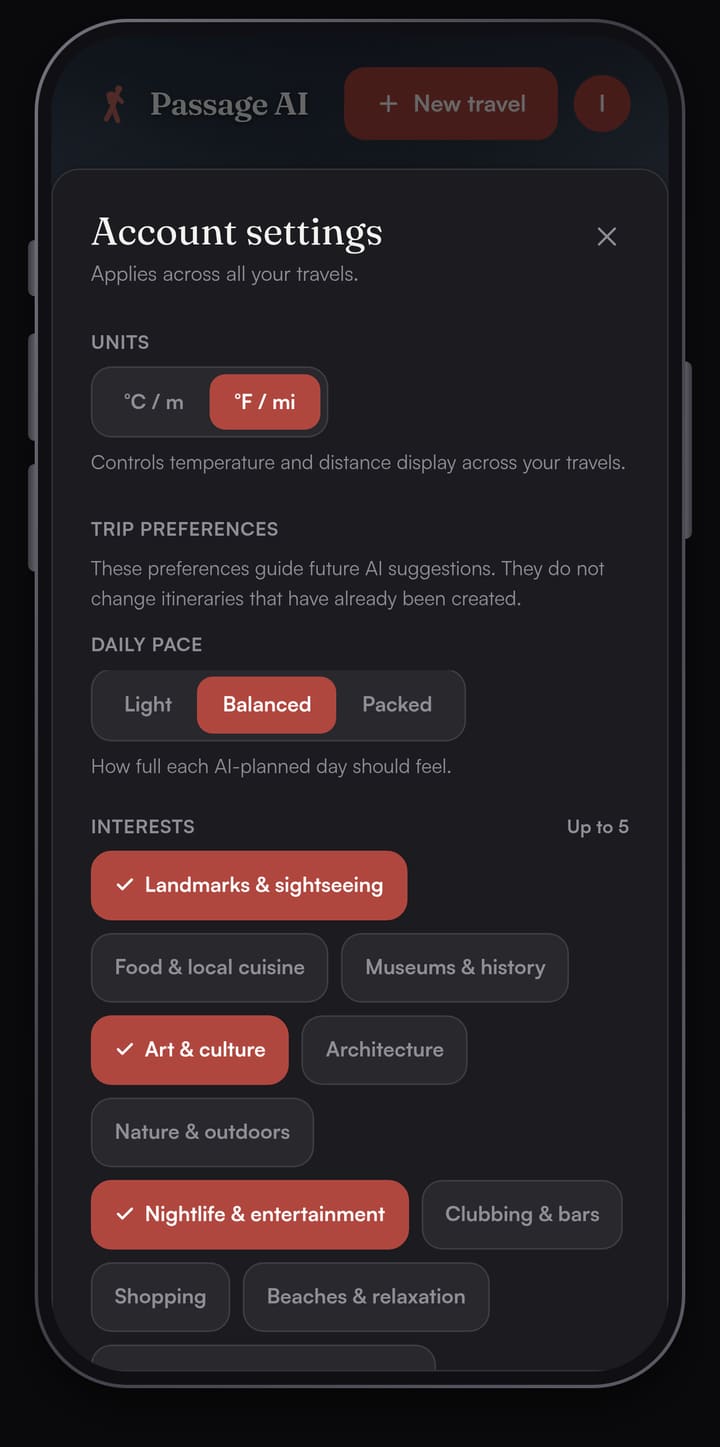
Meals count as stops on Balanced and Packed. The app places breakfast or coffee around 8:00 to 9:30, lunch around 12:00 to 13:30, and on a fuller day dinner around 19:00 to 20:30. So a Balanced day of six stops with two meals is four sights, and a Packed day of nine stops with three meals is six.
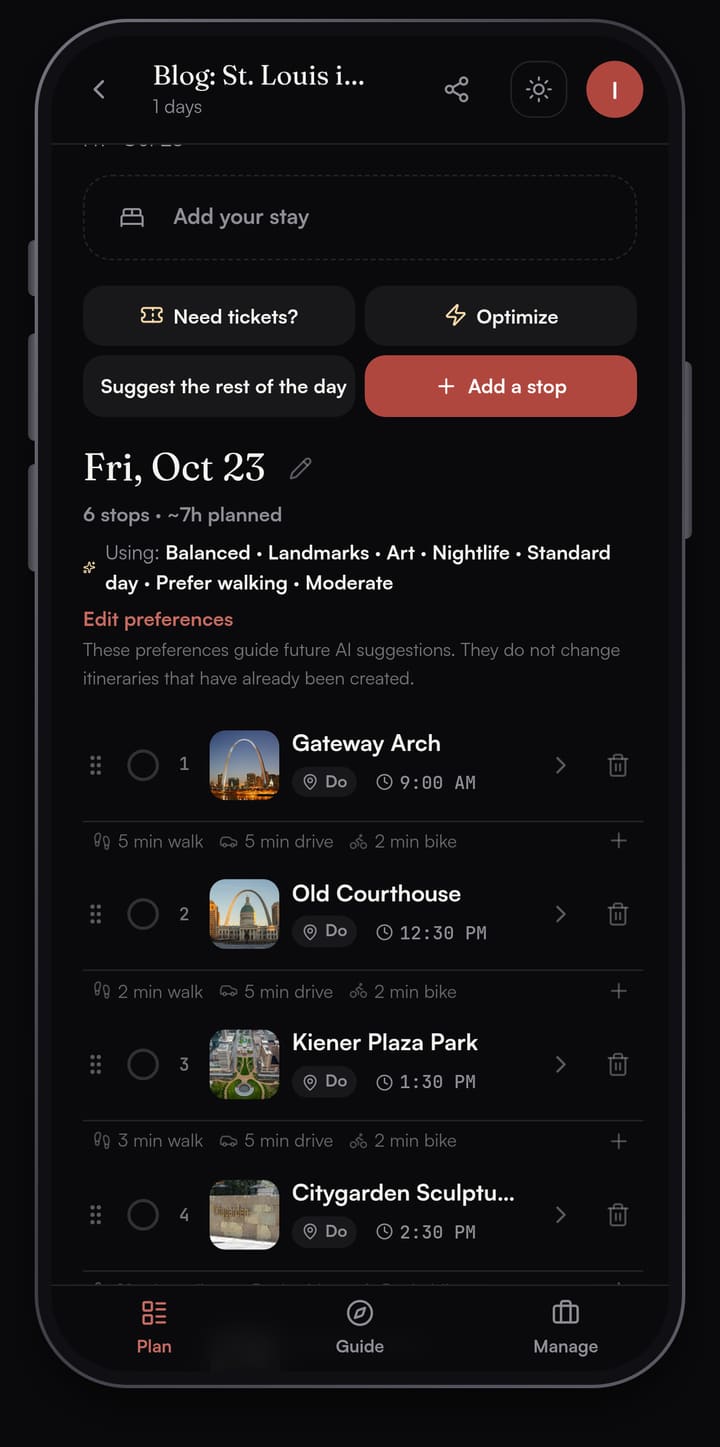
The setting lives in your account settings and shows on each day as a "Using:" line, so you can check what the suggestions were built with. Changing it guides future suggestions and leaves the days you've already planned as they are.
Which one to pick? Light suits an arrival day, a day with kids, or a hot afternoon. Balanced is a full sightseeing day with some sitting down in it. Packed is for when you have one day in a city and you'd rather be tired than miss things. The London day below has 10 stops, one more than Packed aims for.
The walking math: 4.8 km/h, and what it leaves you
The app estimates every walk between stops as a straight line at 4.8 km/h (about 3 mph). That works out to:
- 80 metres a minute
- 12.5 minutes per kilometre
- about 20 minutes per mile
- 1 km between two stops shows as a 13-minute walk
For planning, add about a third to each leg for street routes, crossings and crowds, or if you're walking with kids. Westminster Abbey's visit page is a good benchmark: it puts Charing Cross station about 1,100 metres away, or 16 minutes. On the day, tap Directions on a stop and your phone's maps app gives you the street route.
Now put the numbers on a day. Say a city day has 8 stops, and the legs between them average 8 minutes. That's 7 legs and about an hour of walking, or roughly 4.5 km. Out of an 11-hour day, the walking takes one hour. The other ten hours are the sights and the meals, and that's where the count gets decided.
Six walking days, counted stop by stop
Each of these one-day plans on this blog was built in Passage AI, with the hours checked against the official sites.
| Day | Stops | Meals and drinks | Sights | Walking between stops |
|---|---|---|---|---|
| Rome's historic centre | 9 | 4 | 5 | about 40 min, roughly 3 km |
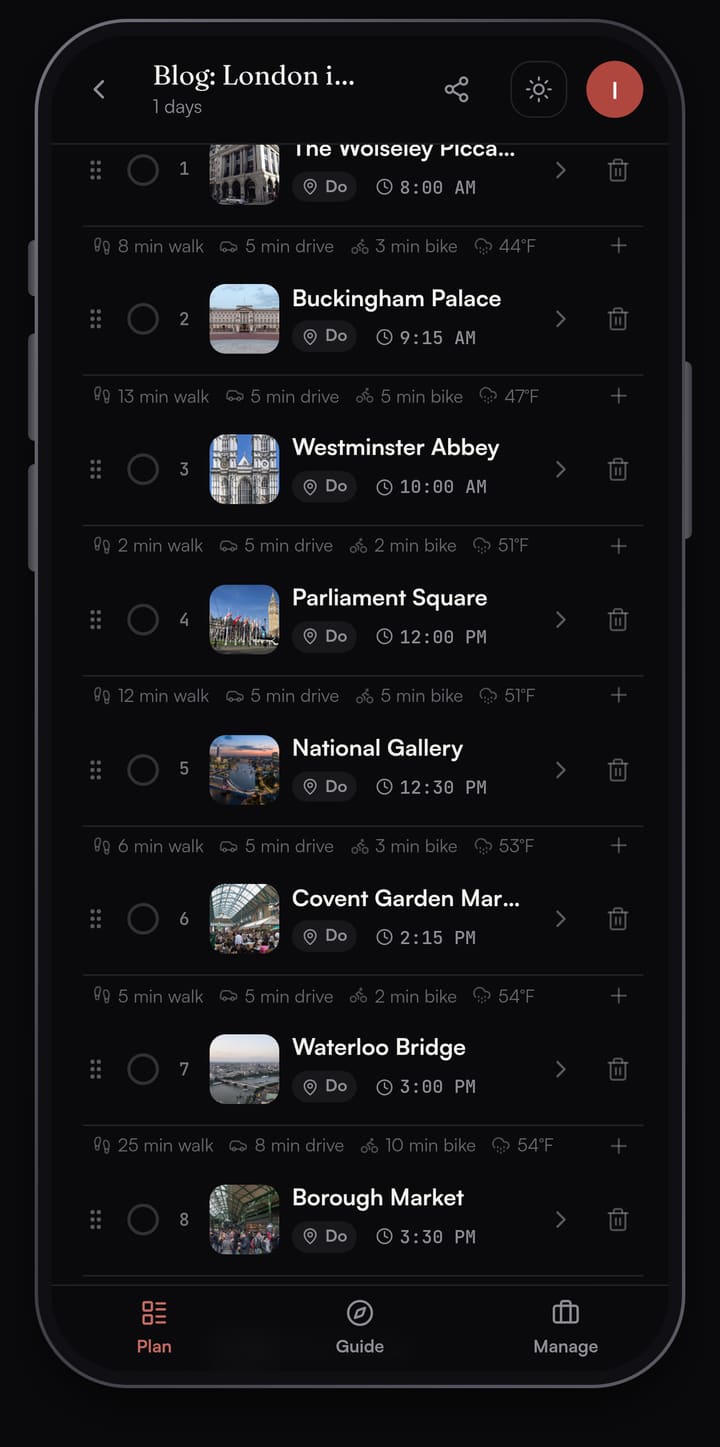
| London | 10 | 3 | 7 | 88 min, about 7 km |
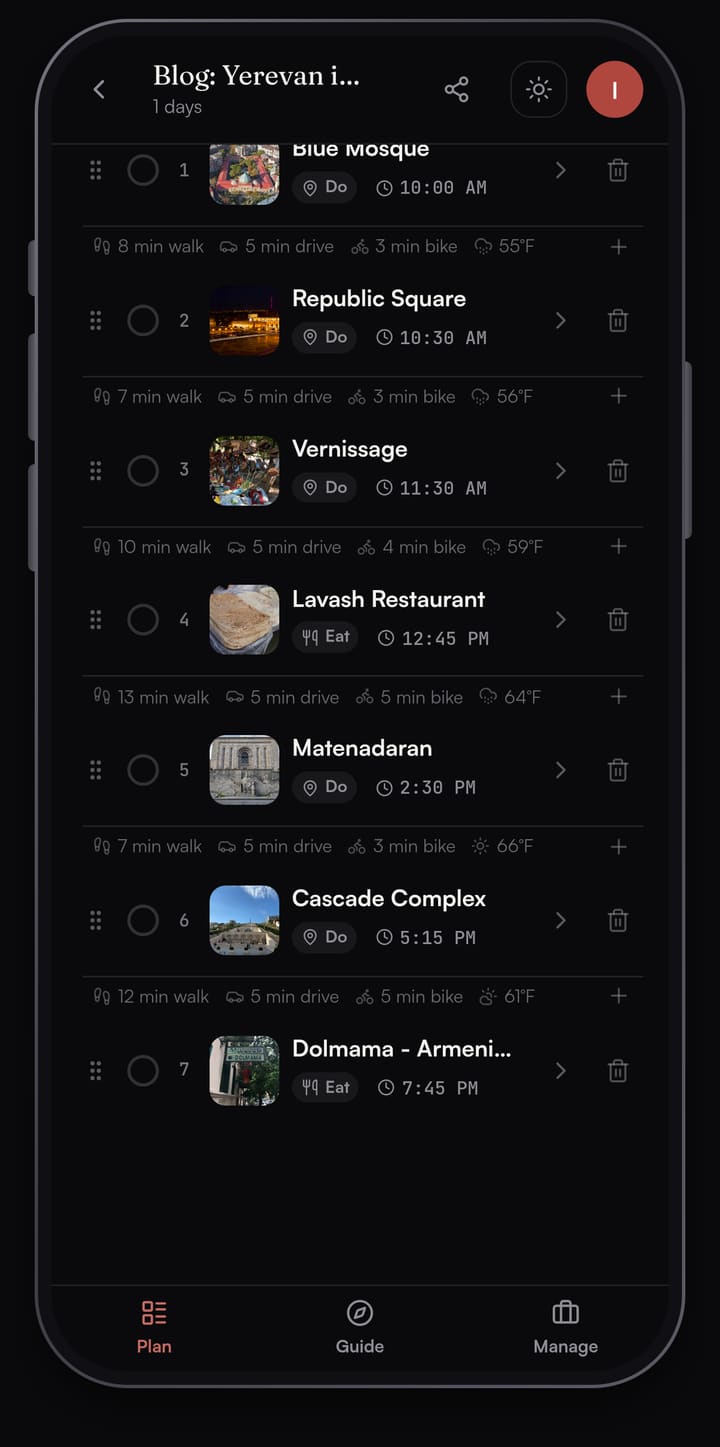
| Yerevan | 7 | 2 | 5 | 57 min, about 4.5 km |
| St. Louis | 6 | 1 | 5 | about 32 min, about 2.5 km |
| Hermann, MO | 8 | 3 | 5 | roughly 3 km |
| Ste. Genevieve, MO | 9 | 1 | 8 | about 20 min |
Walking times are the app's estimates between stops (the Hermann post worked them out the same way from the map). The sights column counts everything that isn't a meal or a drink, the visitor centres included.
Five sights is the common answer. Four of the six days land on five. Those are full days, most of them running from 9:00 or 10:00 into the evening, and most include one long anchor stop.
London fits seven because the sights are on one line. The seven are Buckingham Palace, Westminster Abbey, Parliament Square, the National Gallery, Waterloo Bridge, Borough Market and Sky Garden, with lunch in Covent Garden. Several of those are quick: you cross the bridge and keep walking. It's also the day with the most walking, 88 minutes by the app's count, and two of its afternoon slots are only half an hour apart.
Ste. Genevieve fits eight because it's small. The first seven stops sit within a few blocks, and the walking adds up to about 20 minutes all day. Most of the stops are French colonial houses a few doors apart, and four of them get 40 minutes or less in the plan. A small town lets you see more stops, not bigger ones.
What decides the number
Time inside the big stops
One anchor can take a third of the day. The Gateway Arch tram ride is a 45 to 60 minute experience by the operator's own count, before you add the free museum underneath and the airport-style security screening. The Old Courthouse FAQ from the National Park Service says most visitors take about an hour to see everything. The St. Louis day gives the Arch the whole morning, 9:00 to 12:30, and still fits five sights because the other stops are a few minutes apart.
Opening hours
Many museums open around 9:00 or 10:00 and close in the late afternoon. The Matenadaran in Yerevan, for example, is open Tuesday to Saturday from 10:00 to 17:50 and closed on Sundays and Mondays. At the Gateway Arch the last tram leaves an hour before closing. So the indoor sights have to fit into seven or eight hours. Squares, bridges, viewpoints and markets can take the early morning and the evening, which is how the London and Rome days reach their counts.
Fixed times
Timed tickets, guided tours and meals don't move. Every fixed slot leaves a gap before it, and gaps cost you stops. In Ste. Genevieve, the house tours run at set times, so the day is built around them. That's also why booking ahead matters on a one-day visit: one sold-out time slot can reshape the whole day. Passage AI's Need tickets? scans a trip and flags the stops worth booking ahead, with a link to the official site or a ticket search.
The day of the week
Count the day you'll actually be there. The Yerevan day is set on a Saturday because three of its sights keep different weeks, and a Monday would close both the Matenadaran and the History Museum of Armenia. Many museums close one weekday, so check each anchor's official hours for your date before you count it.
How to count your own day
I use five steps, with round numbers you can change.
- Set the frame. 9:00 to 20:00 is 11 hours.
- Take out the meals. About 3 hours for coffee or breakfast, lunch and dinner. That leaves 8.
- Place the anchors. Give each big museum or tower 2 to 3 hours. With two anchors at 2.5 hours, you have 3 hours left.
- Take out the walking. Add up the distance between stops, multiply by 12.5 minutes per km, then add a third for street routes. For 4.5 km that's about 75 minutes. Call it 1 hour 15, which leaves about 1 hour 45.
- Fill with short stops. At 30 to 40 minutes each, including a little slack, that's three more.
Two anchors and three short stops is five sights. Drop one anchor and you have room for about four more short stops, so seven. That's the same range the six city days landed in.
In Passage AI, Optimize can then reorder a day to cut walking. It shows the new order and times before anything changes, and you can keep your own. On these days it found between 2 minutes (London) and 11 minutes (Hermann) to save. Small numbers, because the walking was never the big block of time.
FAQ
How many museums can you see in one day?
One big museum in full, or two if you're happy with the highlights. A major museum is an anchor stop that takes two to three hours. Small house museums and single-room collections are short stops, and a town like Ste. Genevieve fits several in a day.
How far will I walk in a day of sightseeing?
Between stops, 2.5 to 7 km on the six days above. Walking inside museums and getting to the first stop and back from the last come on top, so your phone's step count will read higher than the planned distance.
How long does it take to walk 1 km?
12.5 minutes at 4.8 km/h, the walking speed Passage AI plans with. With corners and crossings, budget about 15 minutes. Westminster Abbey's own page counts 1,100 metres from Charing Cross as a 16-minute walk.
Is 10 stops in one day too many?
It depends on what they are. Ten stops with three meals and a few quick ones, like a bridge you cross or a market you walk through, is a full day you can do. Ten stops with four big museums isn't. Count the anchors first.
Does Passage AI count meals as stops?
Yes, on Balanced and Packed. Balanced aims for about 5 to 7 stops in total and Packed for about 7 to 9, meals included. Light aims for 3 to 4 main activities and adds a meal or two only where it fits. You set the pace in your account settings.
How this was made: the six city days were planned in Passage AI between 6 and 9 October 2026, the pace and walking-speed numbers were checked against the app's planner settings on 10 October 2026, and facts were checked against the official sites of the Gateway Arch, the National Park Service, the Matenadaran and Westminster Abbey. Written by Edward.
Cover photo: Krzysztof Golik on Wikimedia Commons (CC BY-SA 4.0, cropped)
