Kawagoe in one day on foot: a walking itinerary
This Kawagoe day trip itinerary is a walking day in the old castle town north-west of Tokyo that people call Koedo, "little Edo". It runs from Kitain temple and the castle palace to Hikawa Shrine, Candy Alley, the Toki no Kane bell tower at noon and the storehouse street, with eel for lunch. Eight stops, all on foot, and you finish by mid-afternoon.
I built the day in Passage AI for Tuesday 8 December 2026: I added the eight stops, set the times, ran Optimize and the Need tickets? scan. Hours, prices and closing days below come from the official pages of the temple, the shrine, Kawagoe City and the restaurant, linked where they appear.
Last checked: Nov 2026. Hours and prices change. Open the linked official page before you go.
Getting to Kawagoe
Kawagoe has three stations. Hon-Kawagoe is on the Seibu Shinjuku Line, Kawagoe station on the Tobu Tojo Line and JR Kawagoe Line, and Kawagoe-shi on the Tobu Tojo Line. Kitain lists them as about 15, 20 and 18 minutes' walk from the temple. (Kitain access page) The walk below starts from Hon-Kawagoe and ends back near it.
The Kawagoe day trip itinerary at a glance
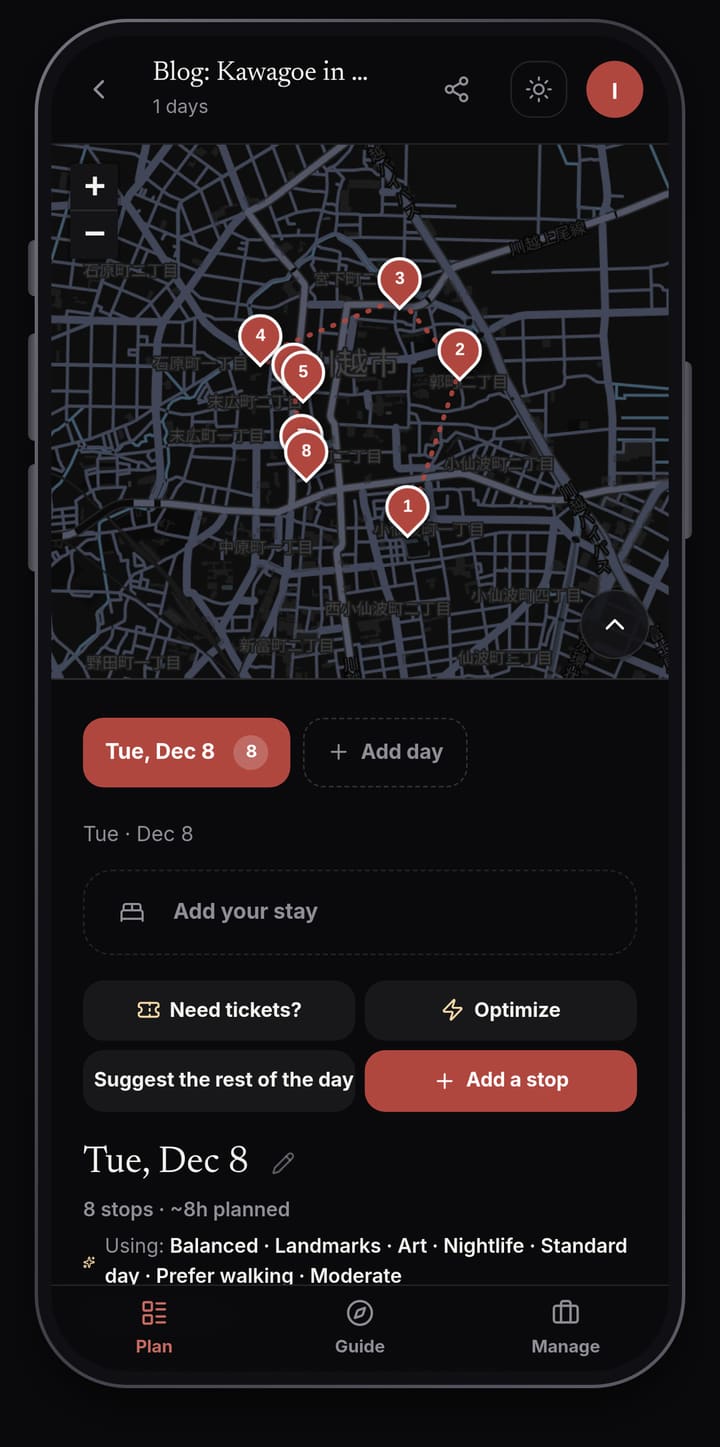
The table shows the day in order, with a time for each stop and the walking minutes to the next one.
| # | Stop | Time | Walk to next stop |
|---|---|---|---|
| 1 | Kitain | 9:00 | about 10 min |
| 2 | Kawagoe Castle Honmaru Goten | 10:30 | about 6 min |
| 3 | Kawagoe Hikawa Shrine | 11:15 | about 9 min |
| 4 | Kashiya Yokocho (Candy Alley) | 11:45 | about 3 min |
| 5 | Toki no Kane bell tower | 12:00 | about 1 min |
| 6 | Kurazukuri street | 12:15 | about 4 min |
| 7 | Ogakiku (eel lunch) | 12:45 | about 1 min |
| 8 | Taisho Roman Yume-dori | 2:15 |
That adds up to about 34 minutes of walking between stops, plus the walk from the station to Kitain at the start. Walk times in Passage AI are straight-line estimates between stops; tap Directions and your phone's maps app opens with the street route.
Stop by stop
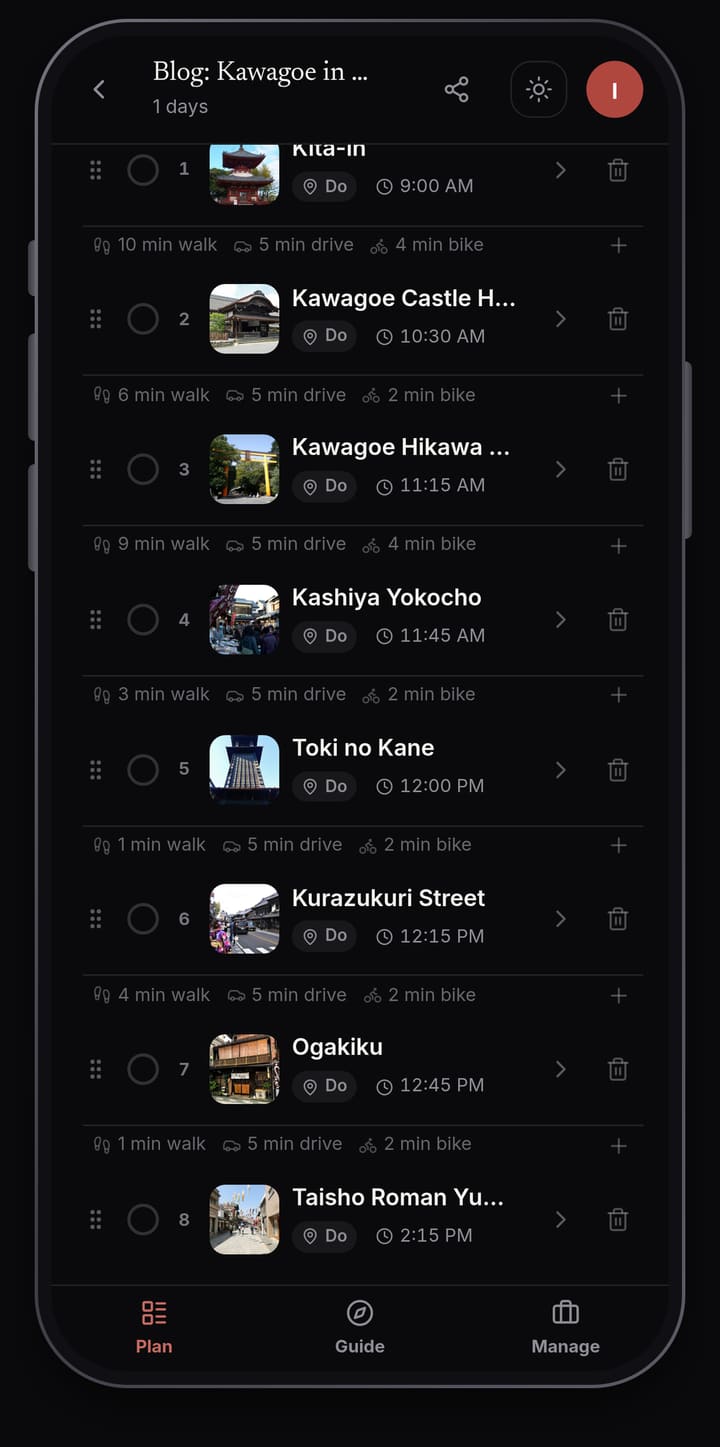
1. Kitain, 9:00
Start at the temple, about 15 minutes on foot from Hon-Kawagoe station (Kitain access page). Tradition dates Kitain to 830. Its fame comes later: after a fire in 1638 the shogun Iemitsu had a guest hall and study moved here from Edo Castle, and the city calls them the only surviving remains of Edo Castle. The city page notes a room said to be where Iemitsu was born. Out by the gate stand the Five Hundred Rakan, 538 stone disciples of the Buddha, each with a different face. (city page)
Entry costs 400 yen for adults and 200 yen for children. From 24 November to the end of February the temple opens 9:00 to 16:00 on weekdays (to 16:20 on Sundays and holidays), and the desk stops selling tickets 30 minutes before closing. From March to 23 November it closes at 16:30 on weekdays. Kitain closes to visitors from 25 December to 8 January, on 2 February afternoon and 3 February, and on 2 to 4 April. (Kitain visiting page) The temple has posted a notice about conservation work on its main gate, so check before you go if the gate matters to you.
Winter afternoons are short here, which is why the day opens at Kitain.
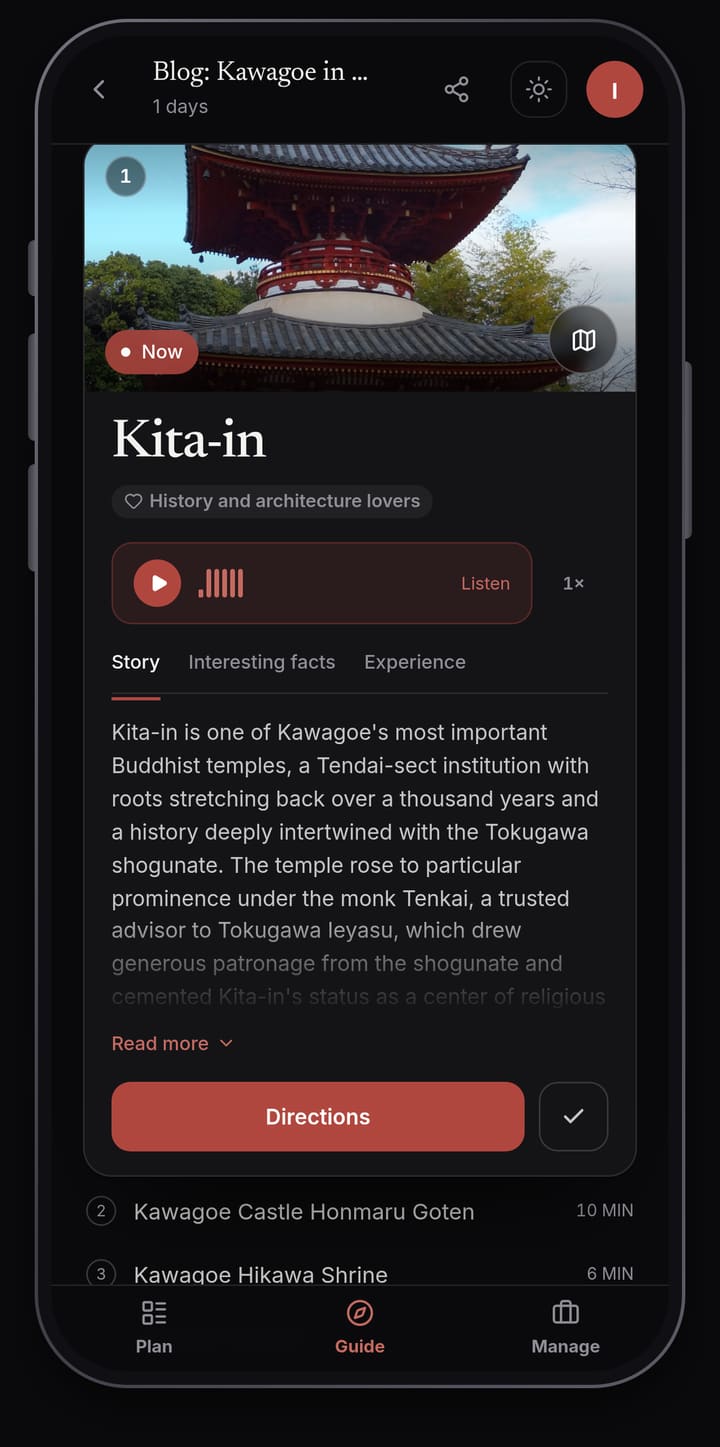
When you reach a stop, Passage AI's Guide opens a card like this with the story of the place, from Tenkai to the rooms moved from Edo Castle. Tap Listen to hear it read aloud as you walk the grounds.
2. Kawagoe Castle Honmaru Goten, 10:30
Little of Kawagoe Castle remains, but its palace does. Lord Matsudaira Naritsune built the Honmaru Goten in 1848. You can see the original entrance hall and the relocated office of the senior retainers,.
It opens 9:00 to 17:00, last entry 16:30, and costs 100 yen for adults (50 yen for high school and university students, free under 15). It closes on Mondays (the next day when Monday is a holiday), on the fourth Friday of each month and from 29 December to 3 January. (official page) The city posts the exact closing days on a calendar page. For December 2026 it lists the 7th, 14th, 21st, 25th and 28th to 31st, so Tuesday 8 December is open.
3. Kawagoe Hikawa Shrine, 11:15
The shrine dates its founding to 541. It served as guardian of the castle town, and the lords of Kawagoe supported it through the Edo period. Its five deities include two married couples, so people come to pray for a good match. The main hall is a national Important Cultural Property. (shrine site)
Visiting the grounds costs nothing. The shrine site lists no opening hours for the grounds, so visit in daylight, as this plan does.
4. Kashiya Yokocho (Candy Alley), 11:45
A short lane of old-style sweet shops. Confectioners worked here from the early Meiji era. After the 1923 earthquake hit Tokyo, the lane took over supplying cheap sweets, and by the early Showa era about 70 makers lined it. Around 30 shops trade today, and Japan's environment ministry named the lane one of its 100 Fragrant Landscapes in 2001. (city page)
Shop hours vary from shop to shop. Buy a snack here and save your appetite for eel.
5. Toki no Kane, 12:00
The wooden bell tower is the symbol of Kawagoe, and the plan puts you under it at noon on purpose. An automatic striker rings the bell four times a day: 6:00, 12:00, 15:00 and 18:00. (city page)
The first tower went up between 1627 and 1634. The one you see was rebuilt in 1894, after the great fire of 1893. It stands three tiers and about 16 metres tall, and its sound made the national list of 100 Soundscapes of Japan in 1996.
6. Kurazukuri street, 12:15
Merchants built these kurazukuri storehouse shops as fireproof buildings in the style of Edo townhouses. Japan made the district a national preservation area for traditional buildings in December 1999. Look for the Osawa House: built in 1792 as a kimono fabric shop, it came through the 1893 fire that burned a third of the town, and the city counts it among the buildings that led local merchants to build in this style. (city page)
The city's Kurazukuri Museum on this street is under seismic strengthening work that the city schedules through fiscal 2026 (to about March 2027), so treat it as closed and check before you go. (city page)
7. Lunch at Ogakiku, 12:45
For lunch, eel: Ogakiku has served it since 1807. The restaurant sits in a three-storey wooden building from the early Taisho era, which the city lists as an important landscape building. An unaju (grilled eel on rice in a lacquer box) costs 3,950 yen including tax.
On weekdays Ogakiku serves lunch 11:00 to 14:00 and dinner 16:30 to 19:30 (last order 19:00). On weekends and holidays it opens 10:40 to 18:30 without a break and takes no seat bookings. It closes on Thursdays, plus some Wednesdays: in November 2026 it closed on the 11th and 25th. The restaurant posts each month's closing days on its home page, so check before you go. When a lot of people are waiting, it can stop taking guests early and asks diners to keep to about an hour. (official site)
8. Taisho Roman Yume-dori, 2:15
Finish on a stone-paved shopping street with a 1910s and 1920s feel, a few minutes from Ogakiku. (city page) Hon-Kawagoe station is a few minutes away on foot.
How Optimize ordered the day
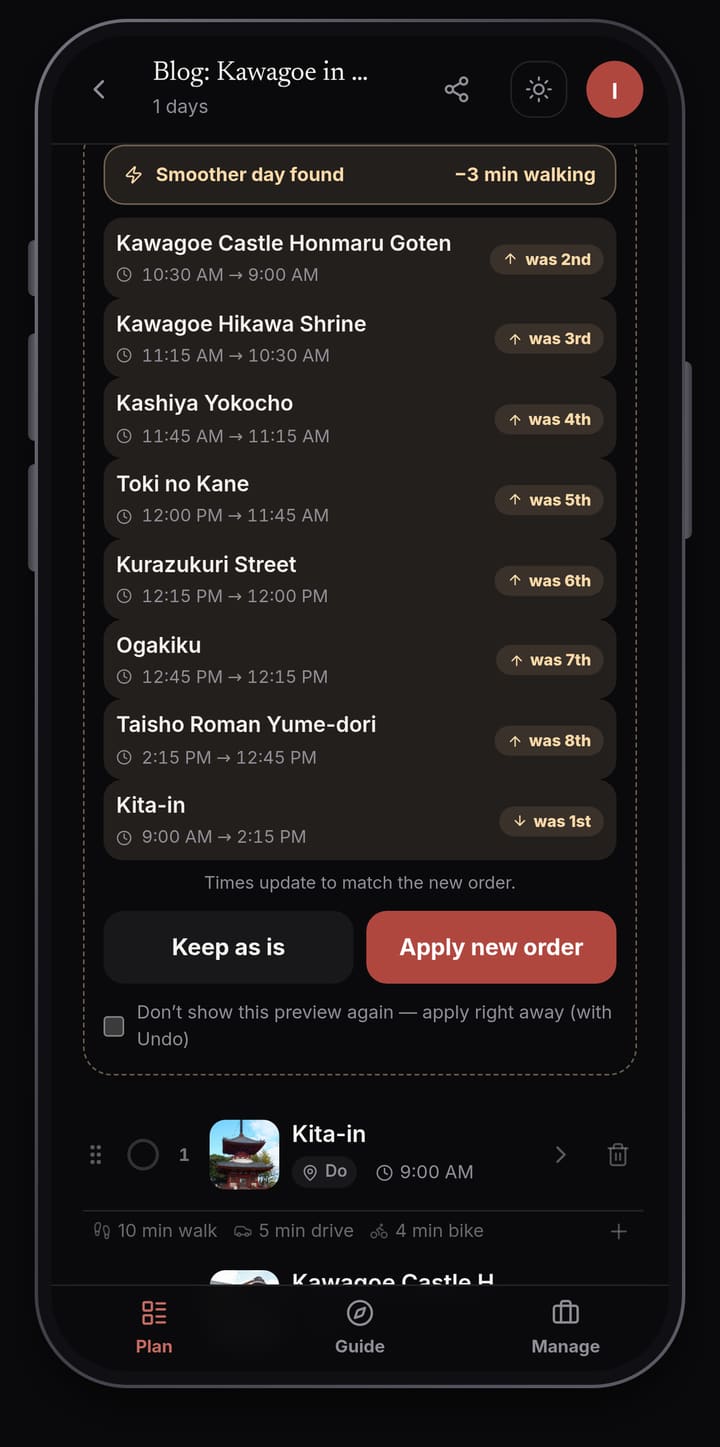
I added the eight stops in this order and pressed Optimize. It found an order with 3 minutes less walking: start at Honmaru Goten at 9:00, run the same loop through the shrine, Candy Alley, the bell tower and lunch, and finish at Kitain at 2:15. Optimize shows each stop's old position and new time before anything changes, and nothing moves until you press Apply.
Both orders work. Kitain still sells tickets until 15:30 on winter weekdays, so a 2:15 arrival leaves plenty of room. I kept Kitain first to start the day at the temple; tap Apply new order if you'd rather take the shorter walk and end the day among the 538 stone rakan.
What Need tickets? flagged
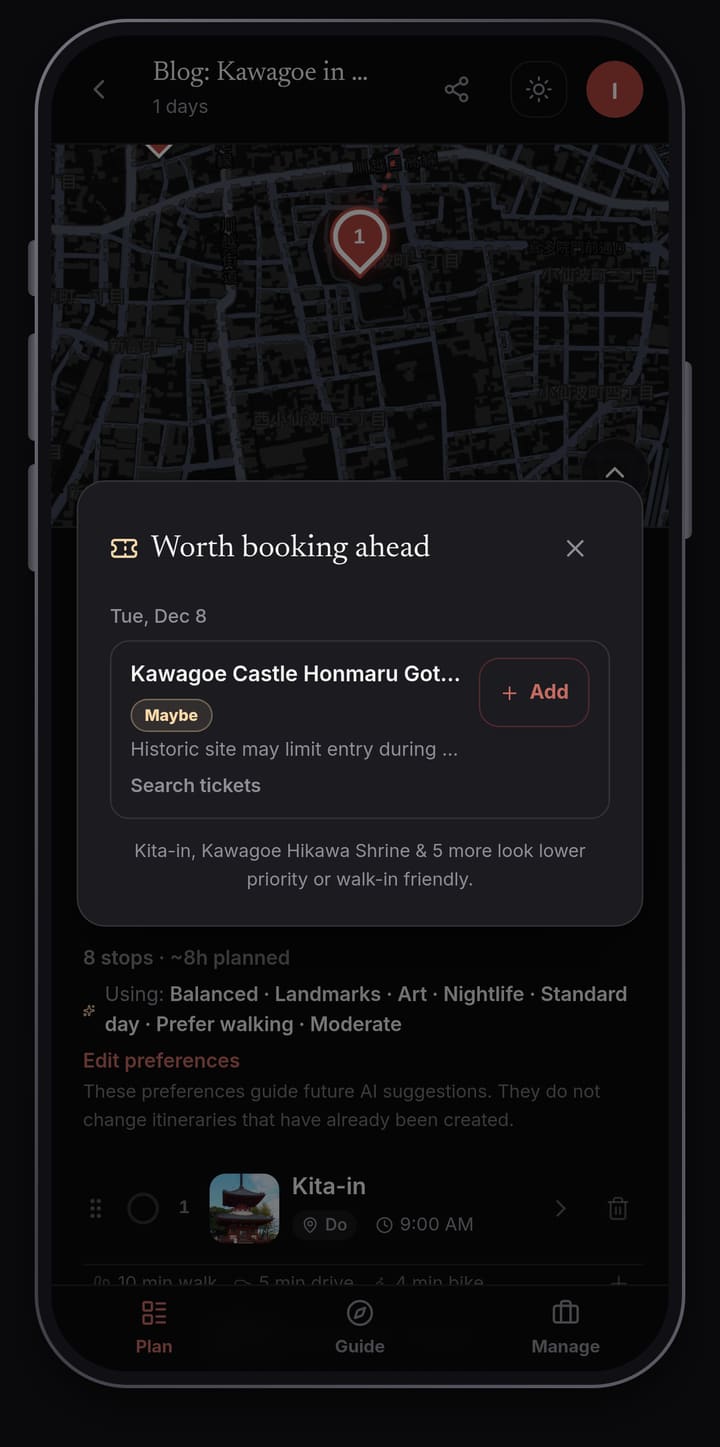
Need tickets? scans the whole trip and marks the stops that usually need booking, with a link to search for tickets. For this day it marked one stop:
| Stop | App said | Official site says (Nov 2026) | My call |
|---|---|---|---|
| Kawagoe Castle Honmaru Goten | Maybe | 100 yen entry, 9:00 to 17:00, no advance booking mentioned | Pay at the door |
It listed Kitain, Hikawa Shrine and the other five stops as lower priority or walk-in friendly. That matches the official pages: Kitain sells entry at its desk until 30 minutes before closing, and the shrine grounds, Candy Alley, the bell tower and the two shopping streets are public streets and grounds. Ogakiku is the one place where a seat can be the issue, so read its notes in the stop above.
What to skip or swap
- Pick your day with care. Honmaru Goten closes on Mondays and the fourth Friday of the month, and Ogakiku closes on Thursdays and some Wednesdays. Tuesday works, and so do most Wednesdays and Fridays once you check both calendars.
- Avoid 25 December to 8 January. Kitain closes to visitors for that stretch, and Honmaru Goten closes from 29 December to 3 January.
- Going on a weekend? Ogakiku takes no seat bookings on weekends and holidays and serves straight through from 10:40, so go at opening or late.
- Feet tired? The Koedo loop bus (小江戸巡回バス) leaves from Kawagoe station's west exit and stops by Hikawa Shrine and by the city museum next to Honmaru Goten. (shrine access page, Honmaru Goten page)
- Want more museums? Honmaru Goten sells a combined ticket with the Kawagoe City Museum, the city art museum and the Kawagoe Festival Hall. (official page)
- Missed the noon bell? Toki no Kane rings again at 15:00 and 18:00.
FAQ
Is one day enough for Kawagoe?
Yes for the old town. Every stop in this plan sits within a walk of the others, and a day covers the temple, the castle palace, the shrine, Candy Alley, the bell tower and the storehouse street with a sit-down lunch.
What time does the Toki no Kane bell ring?
Four times a day, from an automatic striker: 6:00, 12:00, 15:00 and 18:00, according to Kawagoe City.
How much do the sights on this Kawagoe walking itinerary cost?
Kitain is 400 yen for adults and Honmaru Goten is 100 yen. Hikawa Shrine's grounds, Candy Alley, Toki no Kane, the storehouse street and Taisho Roman Yume-dori cost nothing to walk. Lunch is the biggest cost: an unaju at Ogakiku is 3,950 yen.
Do you need to book anything for a Kawagoe day trip?
The sights need no booking. Ogakiku says it takes no seat bookings on weekends and holidays; on weekdays, check its site or call if you want a table.
Is the Kurazukuri Museum open?
Kawagoe City schedules seismic work on the museum's storehouse through fiscal 2026, which ends in March 2027. Treat it as closed and check the city page before you go.
How this was made: planned in Passage AI on 20 November 2026, facts checked against the official sites of Kitain, Kawagoe Hikawa Shrine, Kawagoe City (Honmaru Goten, Toki no Kane, Kashiya Yokocho, the Kurazukuri townscape and Taisho Roman Yume-dori) and Ogakiku, written by Edward.
Cover photo: Zairon on Wikimedia Commons (CC BY-SA 4.0, cropped)
