Tokyo's Asakusa and Ueno in one day on foot: a walking itinerary
This Asakusa and Ueno one day itinerary walks you from Tokyo's oldest temple to the Tokyo National Museum without getting on a train. You start at Kaminarimon and Senso-ji in Asakusa, cross Kappabashi Dougu Street (the kitchen-supply district that sits between the two neighborhoods), spend the afternoon in Ueno Park at the Tokyo National Museum and the National Museum of Western Art, and finish on the Ameyoko market street. The plan has eight stops and runs on a Tuesday.
I built the day in Passage AI in November 2026: I added the eight stops, set a time for each, ran Optimize and the Need tickets? scan. Hours, prices and closing days are checked against the official sites and linked in each section.
Last checked: Nov 2026. Hours and prices change. Open the linked official page before you go.
Don't do this on a Monday. The Tokyo National Museum, the National Museum of Western Art and the National Museum of Nature and Science are all closed on Mondays (when Monday is a national holiday they open and close on Tuesday instead).
The Asakusa and Ueno one day itinerary at a glance
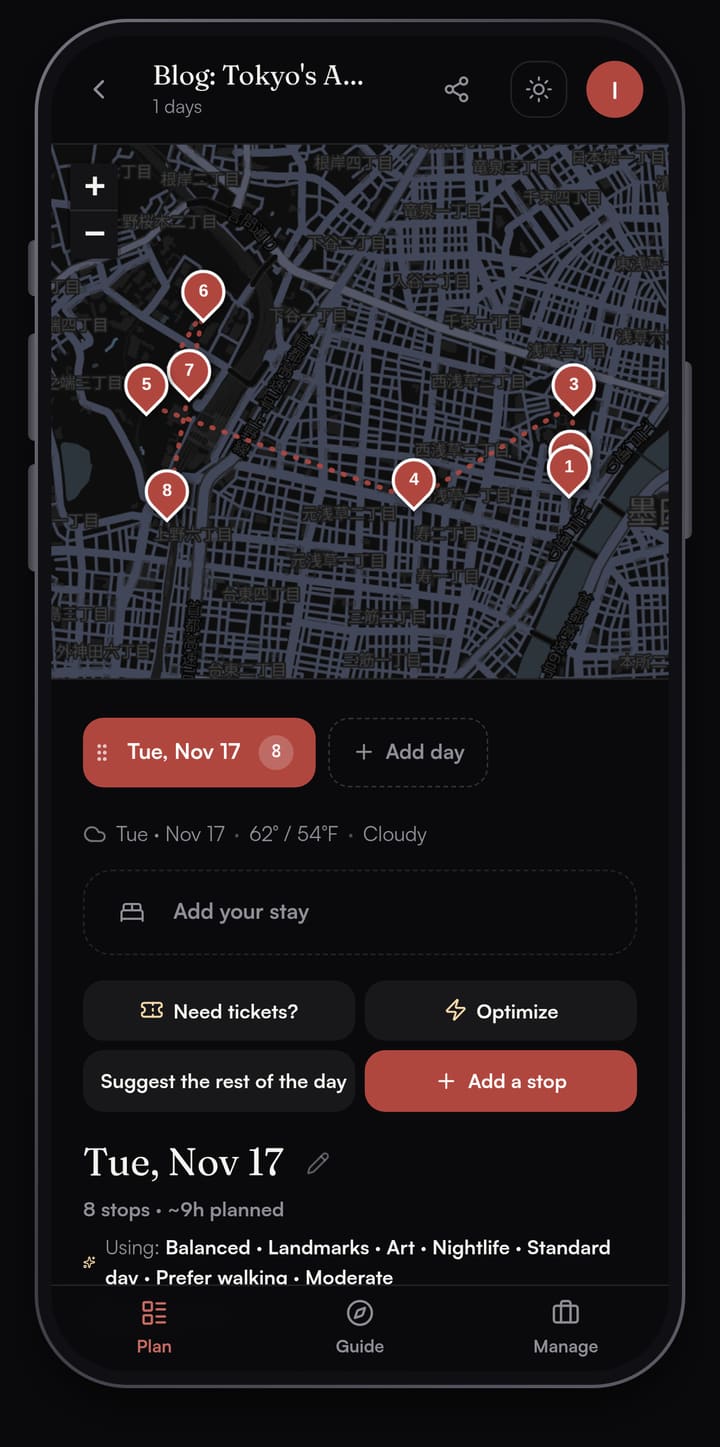
The table shows the day in order, with a time for each stop and the walking minutes to the next one.
| # | Stop | Suggested time | Walk to next stop |
|---|---|---|---|
| 1 | Kaminarimon (Thunder Gate) | 9:00 | 1 min |
| 2 | Nakamise-dori | 9:15 | 4 min |
| 3 | Senso-ji | 9:45 | 11 min |
| 4 | Kappabashi Dougu Street | 10:45 | 17 min |
| 5 | Ueno Park (lunch) | 12:00 | 7 min |
| 6 | Tokyo National Museum | 13:00 | 5 min |
| 7 | National Museum of Western Art | 15:30 | 8 min |
| 8 | Ameyoko | 17:00 |
The walks add up to 53 minutes, and the longest leg, Kappabashi to Ueno Park, is 17. Walk times in Passage AI are straight-line estimates between stops at walking pace; tap Directions and your phone's maps app opens with the street route.
Stop by stop
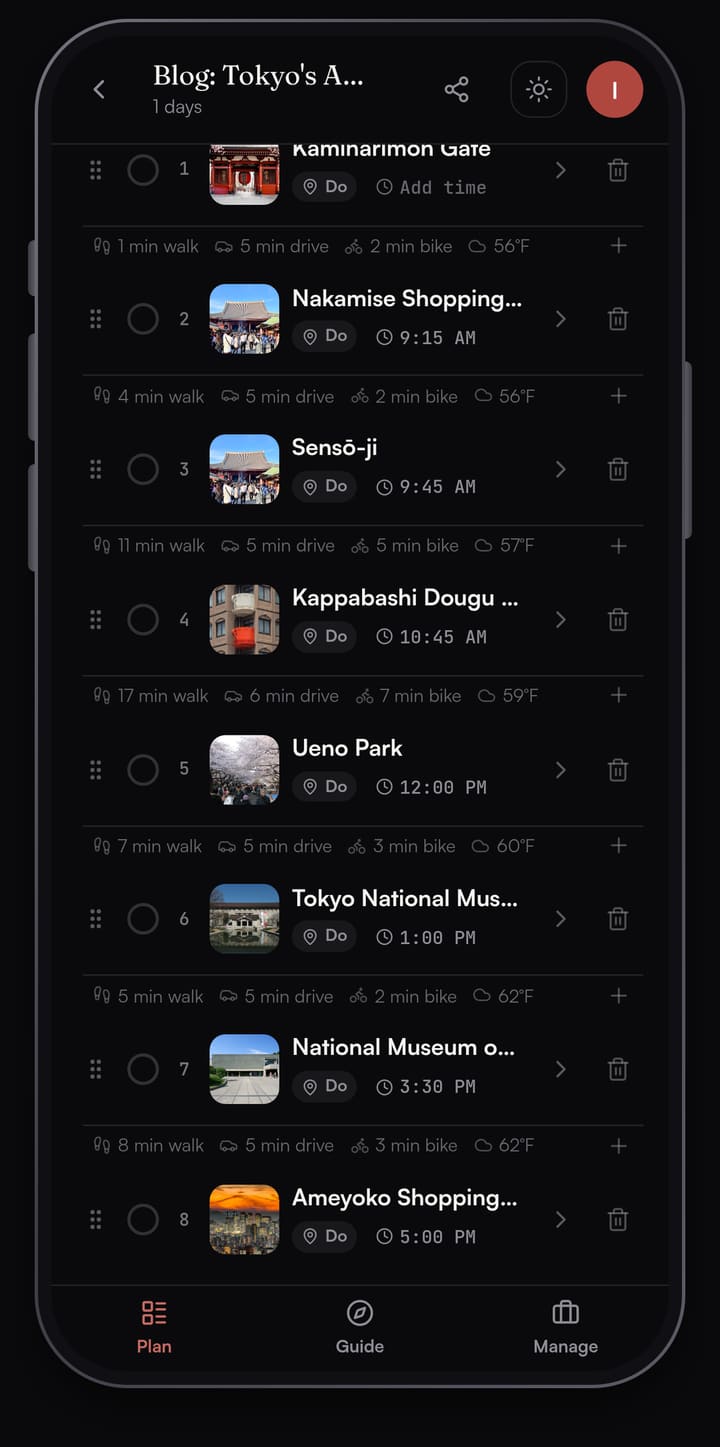
1. Kaminarimon, 9:00
The Thunder Gate is the front door of Senso-ji and the start of the day. It was first built in 942 by the commander Taira no Kinmasa, and the statues of Fujin (wind) and Raijin (thunder) on either side guard the temple. A fire in December 1865 destroyed it. The gate you see now went up 95 years later, paid for by Konosuke Matsushita, the founder of Matsushita Electric. (Senso-ji)
The gate is on the street, so there's no ticket and no opening time. At 9:00 the crowd under the big red lantern is still thin enough for a photo.
2. Nakamise-dori, 9:15
The shopping street from Kaminarimon to the temple's inner gate is one of the oldest in Japan, and GO TOKYO counts about 90 shops on it: rice crackers, sweet bean cakes, folding fans, toys. (GO TOKYO) The shops open later than the temple grounds, so some shutters may still be down at 9:15. Walk it now while it's quiet, and come back for snacks later if you want them.
3. Senso-ji, 9:45
Senso-ji is the oldest temple in Tokyo. The temple's story starts on 18 March 628, when two brothers fishing in the Sumida River pulled a statue of Kannon out in their net, and a hall for it was built in 645. The statue has been kept hidden from view ever since. (Senso-ji)
The main hall opens 6:00 to 17:00, and 6:30 to 17:00 from October to March. (Senso-ji access page) Entry to the grounds is free. (GO TOKYO) Give it 45 minutes for the main hall, the five-story pagoda and the incense burner out front.
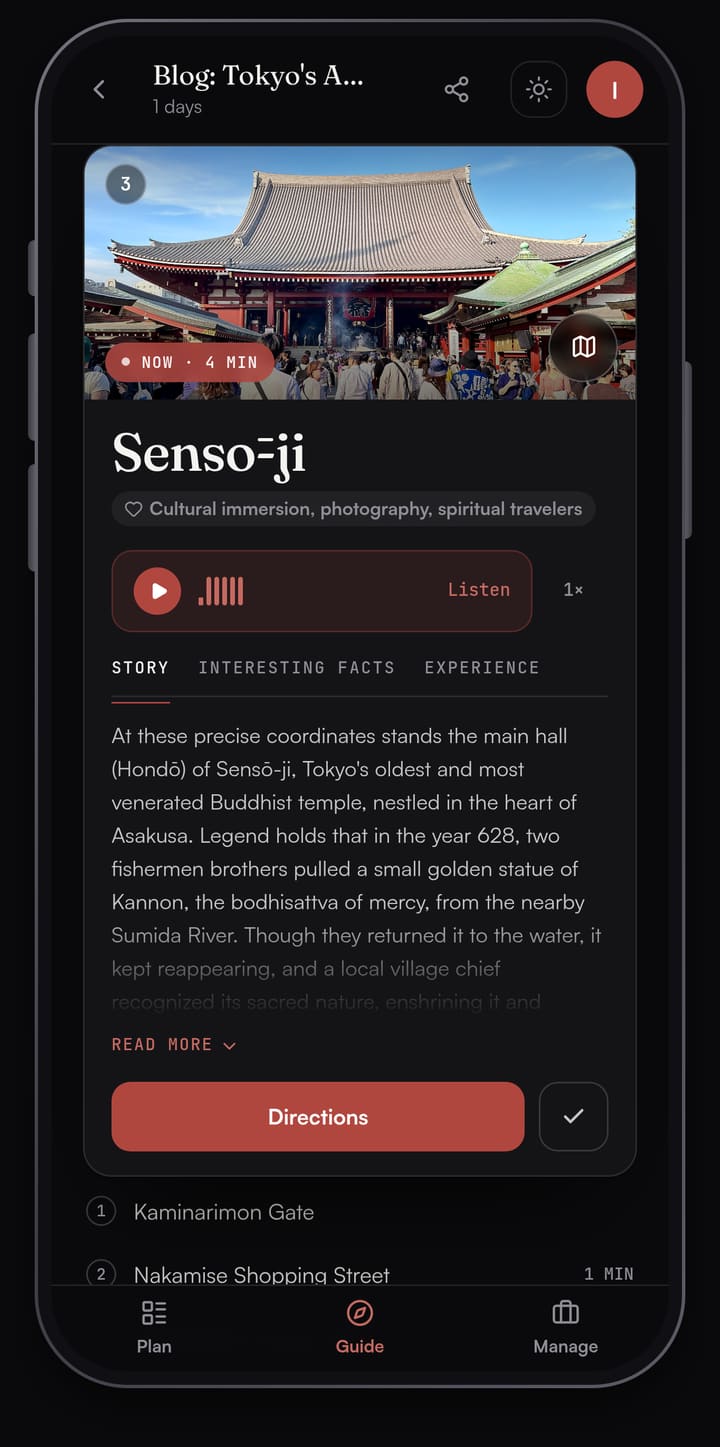
When you reach a stop, Passage AI's Guide opens a card like this one with the story of the place. Tap Listen to have it read aloud while you stand in front of the hall.
4. Kappabashi Dougu Street, 10:45
Head west from the temple to Tokyo's kitchen-supply street. Merchants started gathering here around 1912, and today the shops sell nearly every kind of restaurant equipment: knives, pots, lacquer bowls, paper lanterns, and the plastic food samples you see in restaurant windows. The street sits midway between Asakusa and Ueno, so you walk through it on the way from the temple to the park. (Kappabashi Dougu Street overview)
The street is always open, but each shop sets its own hours and days off. The association says most shops open on Saturdays and about 30% open on Sundays, so a weekday is the safest choice. (Kappabashi Q&A) Shop hours vary, so check before you go if one store is the reason you're coming.
5. Ueno Park, 12:00
Keep walking west to Ueno Park (Ueno Onshi Koen), the park known for its cherry trees and Shinobazu Pond. It's open at all hours and free to enter, though some facilities inside charge. (Tokyo Metropolitan Park Association, Japanese) This is the lunch stop. Eat around the park before the museums, because the afternoon is mostly indoors.
6. Tokyo National Museum, 13:00
Plan the longest visit of the day here. The museum opens 9:30 to 17:00, until 20:00 on Fridays and Saturdays, with last admission 30 minutes before closing. It's closed on Mondays (when Monday is a holiday it opens and closes the next day instead), and closed from 26 to 31 December 2026. (TNM hours and admission)
A collection ticket costs 1,000 yen for adults and 500 yen for university students. You can buy it on your phone, and it stays valid for two months from purchase, so buying it the night before costs you nothing. The museum says the ticket queue at the main gate can take more than 30 minutes at busy times. Special exhibitions have their own tickets, which also get you into the collection the same day. Check the TNM site for what's on.
Two and a half hours is enough for the Japanese Gallery (Honkan) and one more building.
7. National Museum of Western Art, 15:30
A 5-minute walk across the park takes you to the National Museum of Western Art, in a building by Le Corbusier completed in March 1959. The museum describes it as a World Heritage Site. (NMWA building) The permanent collection is open 9:30 to 17:30, until 20:00 on Fridays and Saturdays, with admission ending 30 minutes before closing. It's closed on Mondays (same holiday rule) and from 28 December to 1 January. A collection ticket costs 500 yen for adults. Special exhibitions are priced separately, and their tickets include the collection. (NMWA visitor information)
Arriving at 15:30 on a weekday gives you an hour and a half before last admission at 17:00.
8. Ameyoko, 17:00
End the day on Ameyoko, the market street that runs about 500 meters from Ueno Station to Okachimachi Station. GO TOKYO counts about 500 shops and stalls: fresh seafood, snacks and sweets, clothes, cosmetics, and food from all over. (GO TOKYO) Each shop keeps its own hours, so check before you go if you're coming late. Ueno Station is at the north end and Okachimachi Station at the south, so either one gets you home.
How Optimize ordered the day
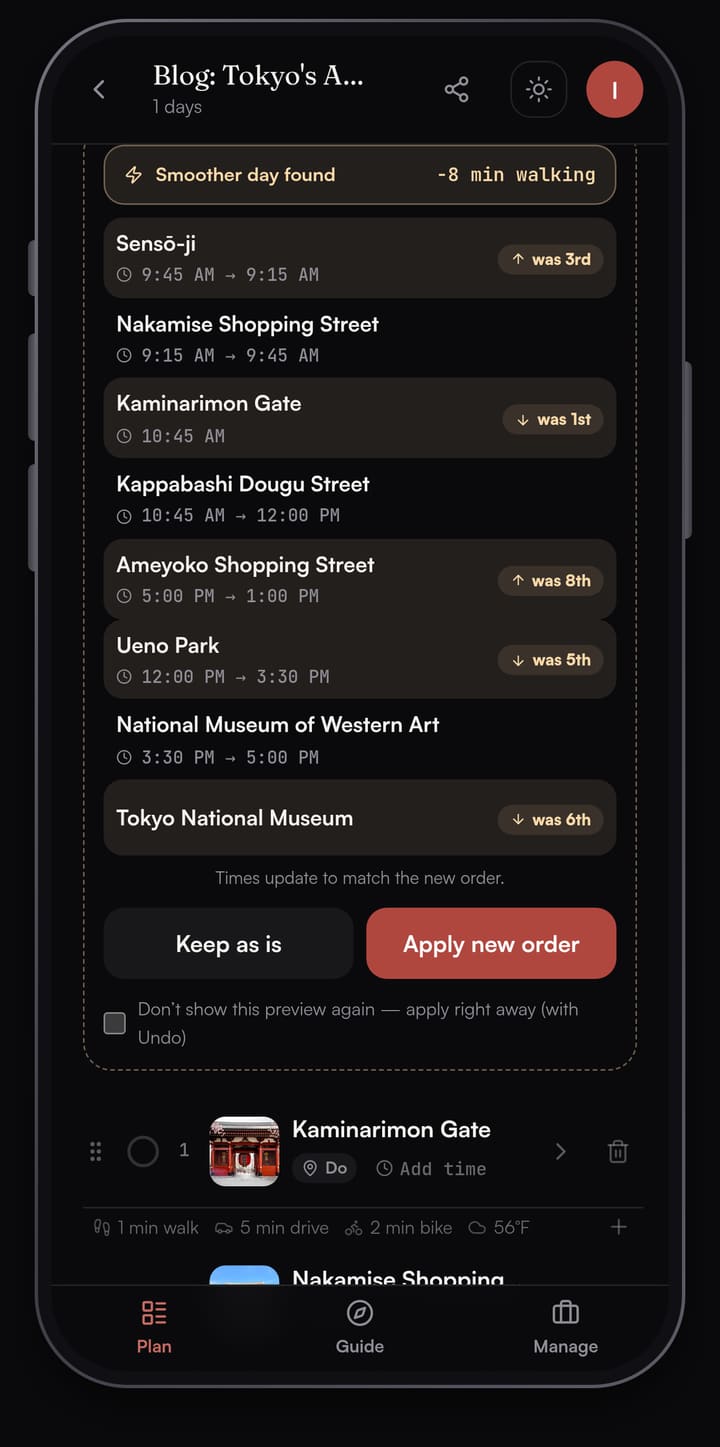
Optimize found an order with 8 minutes less walking. It shows a preview with each stop's old position, and nothing changes until you press Apply. Both orders work. I kept the original one so the day starts at the temple's front gate and ends on Ameyoko, a short walk from Ueno Station. Tap Apply if you'd rather take the shorter walk.
What Need tickets? flagged, checked against the official sites
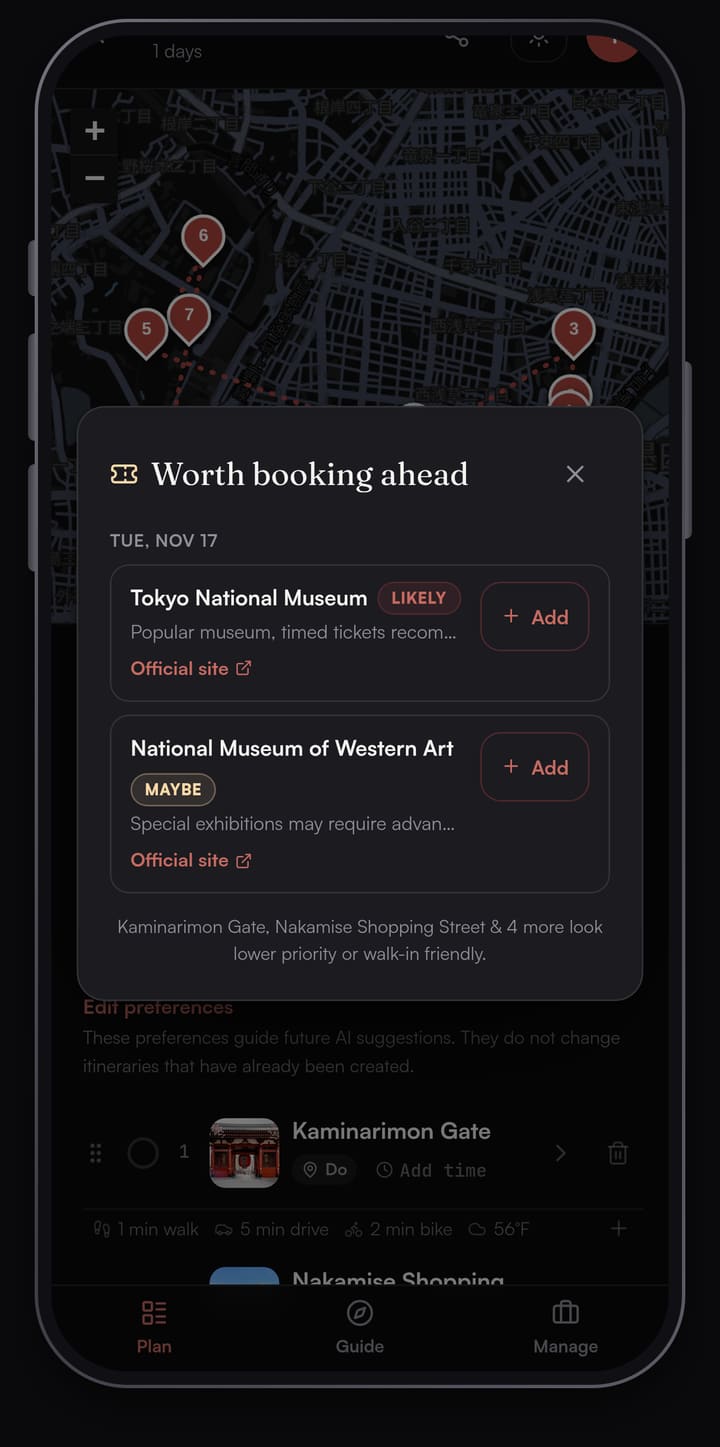
Need tickets? scans the whole trip, marks the stops worth booking ahead and links you to each official site. For this day it flagged two:
| Stop | App said | Official site says (Nov 2026) | My call |
|---|---|---|---|
| Tokyo National Museum | Likely | Queue at the gate can top 30 min; buy online, valid two months | Buy online the night before |
| National Museum of Western Art | Maybe | Collection 500 yen; special exhibitions priced separately | Book only for a special exhibition |
The other six stops came back as walk-in, which matches the official pages: Senso-ji and its gate are free, Nakamise, Kappabashi and Ameyoko are public streets, and Ueno Park is free and open at all hours.
Ways to change the Asakusa and Ueno itinerary
- Swap a museum for dinosaurs. The National Museum of Nature and Science is next door to the Western Art museum. It opens 9:00 to 17:00, is closed on Mondays, and costs 630 yen for adults, with high school students and younger free. Part of its Global Gallery (the third basement floor) is closed for renovation from 8 September 2026. (Kahaku visitor information)
- Short on energy? The Ginza Line runs from Asakusa Station to Tawaramachi (5 minutes' walk from Kappabashi) and on to Ueno, so you can ride one leg instead of walking it. (Kappabashi access)
- Late museum. On a Friday or Saturday both art museums stay open until 20:00, so you can swap the order: Ameyoko before dinner, museums after.
- Visiting in December? Senso-ji holds its Hagoita (decorated paddle) market from 17 to 19 December, and the grounds get busy. (Senso-ji) The Tokyo National Museum closes from 26 December.
FAQ
Can you do Asakusa and Ueno in one day?
Yes. The two neighborhoods are next to each other, with Kappabashi Dougu Street in between, so you can walk from Senso-ji to Ueno Park and spend the afternoon at the museums. Start at Senso-ji in the morning and keep the museums for after lunch.
Is it better to start in Asakusa or Ueno?
Start in Asakusa. Senso-ji's main hall opens at 6:30 from October to March and 6:00 the rest of the year, well before the Ueno museums open at 9:30, and the temple is quieter early. Ending at Ameyoko puts you on a lively street at the end of the day, next to Ueno Station.
Is the Tokyo National Museum open on Mondays?
No. It's closed on Mondays. When a Monday is a national holiday the museum opens that day and closes on the Tuesday instead. The National Museum of Western Art and the National Museum of Nature and Science follow the same rule.
Do you need to book Tokyo National Museum tickets in advance?
You don't have to, but it helps. The museum says the ticket queue at the main gate can take more than 30 minutes at busy times and recommends buying online. A collection ticket is 1,000 yen for adults and stays valid for two months from purchase.
Is Senso-ji free?
Yes. Entering the temple grounds and the main hall costs nothing. The main hall is open 6:00 to 17:00, from 6:30 between October and March.
Does the plan open offline?
Saved plans in Passage AI open offline, so you can check the next stop and its time without a signal. An Android app is coming soon; on Android today you can plan in the browser at mypassage.ai.
How this was made: planned in Passage AI on 6 November 2026, facts checked against the official sites of Senso-ji, the Tokyo National Museum, the National Museum of Western Art, the National Museum of Nature and Science, Kappabashi Dougu Street, the Tokyo Metropolitan Park Association and GO TOKYO, written by Edward.
Cover photo: Kakidai on Wikimedia Commons (CC BY-SA 3.0, cropped)
