Harpers Ferry in one day on foot: a Lower Town walking itinerary
This Harpers Ferry one day walking itinerary keeps you on foot in Lower Town, the 19th-century streets at the bottom of the hill where the Potomac and Shenandoah rivers meet. Lower Town is part of Harpers Ferry National Historical Park, and its museums and exhibits are included in the park entrance pass. The day goes in walking order: the armory story on Shenandoah Street, John Brown's Fort and The Point in the late morning, then the 1810 stone steps up to Jefferson Rock and on to the old Storer College campus on Camp Hill.
I built the day in Passage AI for Wednesday, 18 November 2026, an ordinary weekday when every open exhibit keeps its normal hours. The park is open every day of the year except Thanksgiving Day, 25 December and 1 January. Hours, fees and closures below are checked against the National Park Service pages and linked inline.
Last checked: Nov 2026. Hours, fees and closures change. Open the linked NPS page before you go.
Harpers Ferry one day walking itinerary at a glance
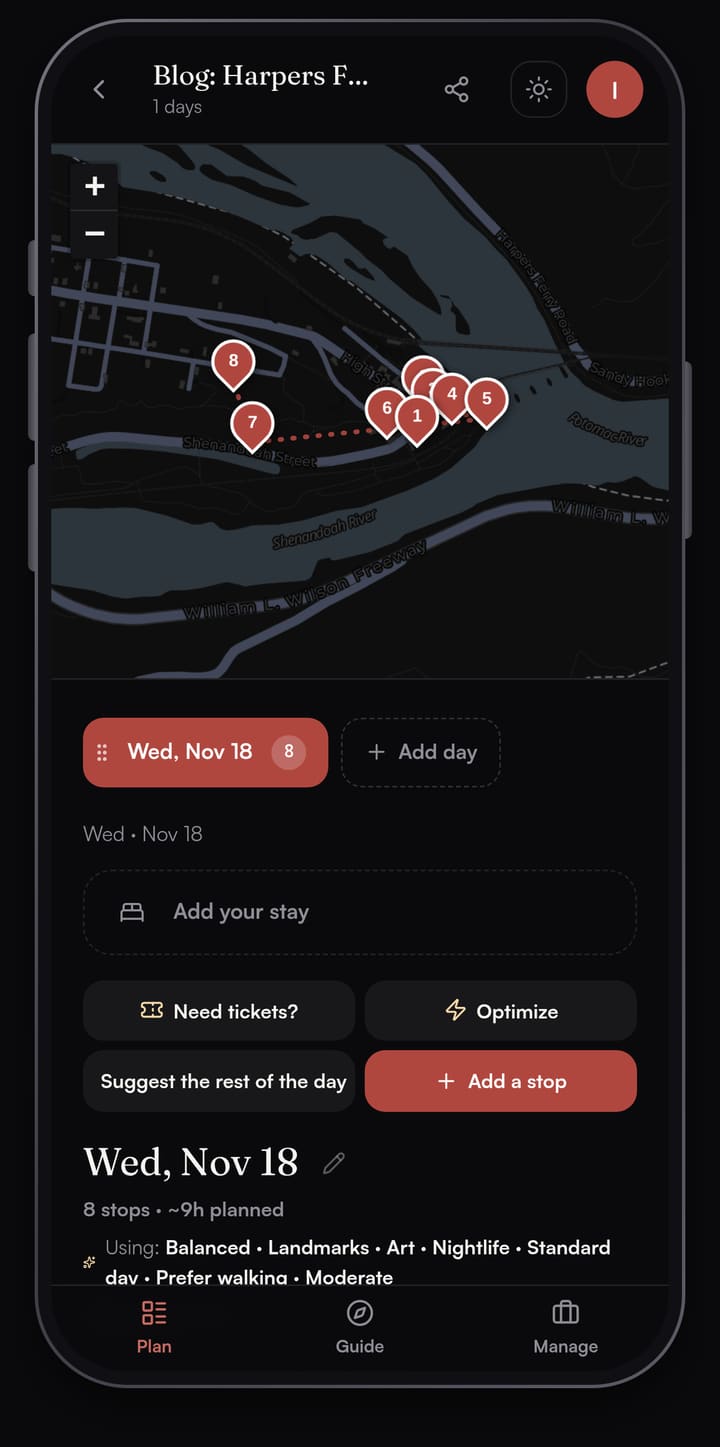
The table shows the day in order, with a time for each stop and the walking minutes to the next one.
| # | Stop | Suggested time | Walk to next stop |
|---|---|---|---|
| Industry Museum (warm-up) | 9:30 | ||
| 1 | Dry Goods Store and the 19th-century shops | 10:10 | about 1 min |
| 2 | White Hall Tavern | 10:40 | about 1 min |
| 3 | John Brown Museum | 11:00 | about 1 min |
| 4 | John Brown's Fort | 11:45 | about 1 min |
| 5 | The Point | 12:05 | about 3 min |
| Lunch | 12:30 | ||
| 6 | St. Peter's Roman Catholic Church, via the stone steps | 1:15 | about 4 min |
| 7 | Jefferson Rock | 1:35 | about 2 min |
| 8 | Lockwood House and the Storer College campus | 2:15 |
That's about 13 minutes of walking between the eight stops. Walk times in Passage AI are straight-line estimates between stops at walking pace; tap Directions and your phone's maps app opens with the street route. The afternoon legs climb stone steps and a hillside path, so take them slowly.
Getting there, the park pass and the shuttle
Start at the park's Visitor Center, 171 Shoreline Drive, off US Route 340. The NPS says many navigation apps send drivers to the town itself, to Lower Town (where parking is limited) or to the park headquarters, so put the Visitor Center address in your maps app (directions).
You need an entrance pass in every part of the park, Lower Town included. A private vehicle pays $20, a motorcycle $15, and anyone arriving on foot or by bike pays $10 per person (under 16s are free). Every pass is valid for three consecutive days, and the park takes no cash: pay by card at the entrance station next to the Visitor Center, or buy the pass online before you go (fees).
From the Visitor Center, the park shuttle bus runs down to Lower Town every 10 to 15 minutes, every day the park is open, and the ride is included in the entrance fee. There are only two stops, the Visitor Center and Lower Town. In winter (Eastern Standard Time, 2 November 2026 to 14 March 2027) service starts at 9:00 and the last bus leaves Lower Town at 5:30 p.m. From March it runs until 7:00 p.m. Pets aren't allowed on the shuttle or in park buildings; service animals are (getting around). If you'd rather walk down, the Visitor Center to Lower Town Trail starts at the same lot.
The entrance fee also covers parking at the Visitor Center lot, ranger programs, and the park museums, exhibits and trails (parking), so every museum on this route is included in your pass.
Lower Town's museums, exhibits and restrooms are open 9:00 to 5:00 every day. Trails and parking lots open 30 minutes before sunrise and close 30 minutes after sunset.
Stop by stop
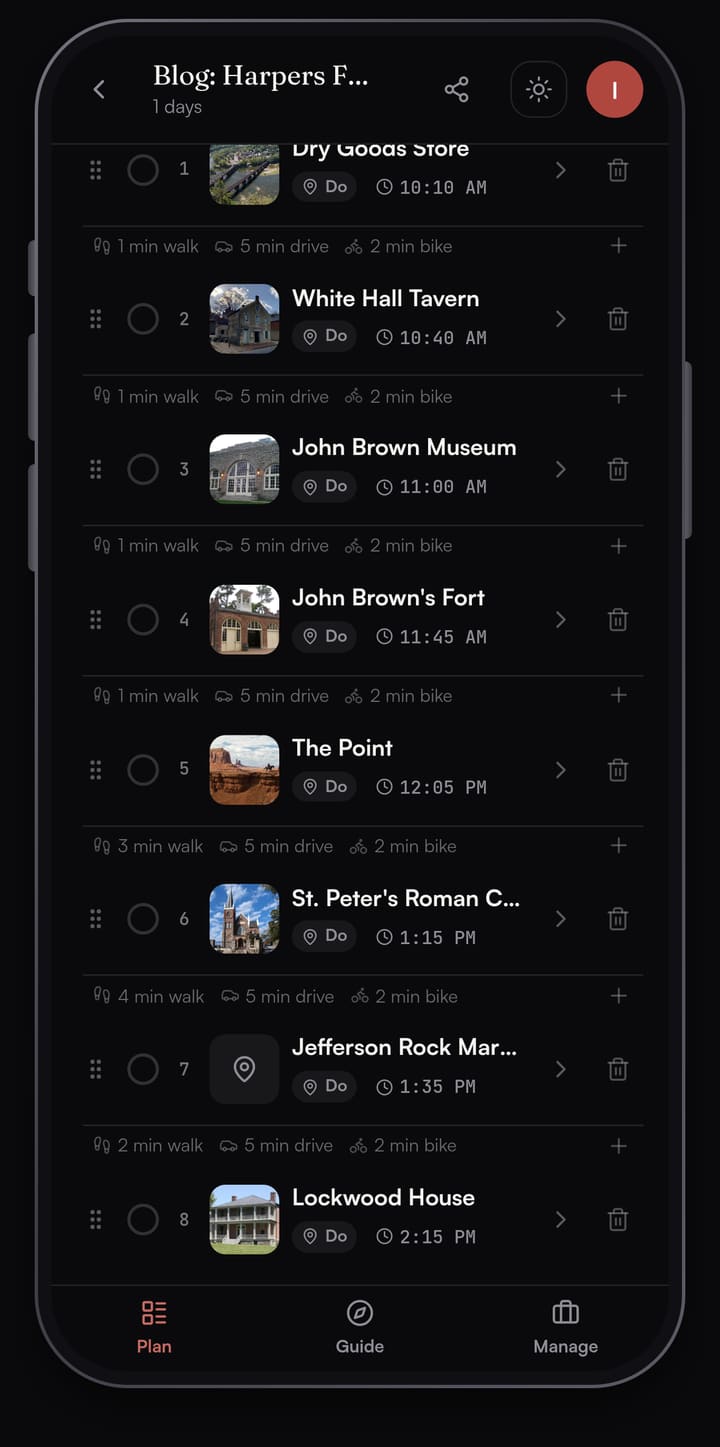
The shuttle drops you at the Lower Town end of Shenandoah Street. Everything until lunch sits along that one street, and the John Brown story and The Point are at its far end.
Warm-up: the Industry Museum, 9:30
Before the first stop, give half an hour to the Industry Museum in Lower Town. It starts with the reason the town exists. George Washington picked Harpers Ferry for the second national armory, after Springfield, Massachusetts. Building started in 1799, and by 1810 the armory was turning out about 10,000 muskets, rifles and pistols a year. The workforce grew from 25 men in 1802 to about 400 by 1859 (armory history). The NPS files the Industry Museum under Harpers Ferry as an industrial center. It's the background for the rest of the day: in 1859 John Brown's raid began by seizing this armory.
1. Dry Goods Store and the 19th-century shops, 10:10
Several old buildings in Lower Town are furnished to show the town's 19th-century life: the Dry Goods Store, the Boarding House, the Confectionery, Philip Frankel & Co. ready-made clothing and A. Burton's watch repair and jewelry store. The NPS groups them as "the town's 19th century landscape", and the A Place in Time exhibit is where to pick up a paper map, since the Lower Town Information Center isn't staffed by rangers at the moment (current conditions). Take them in whatever order you pass them.
2. White Hall Tavern, 10:40
Another of the 19th-century buildings, listed by the NPS as open, and about a minute's walk from the Dry Goods Store. Look in before you get to the John Brown sites.
3. John Brown Museum, 11:00
The John Brown Museum tells the story of the raid of 16 to 18 October 1859. Brown and his men seized the armory on the Sunday night. Colonel Robert E. Lee and 90 U.S. Marines arrived by train late the next day, and at 7:00 the following morning, after Brown refused to surrender to Lieutenant J.E.B. Stuart, the Marines broke into the engine house. Sixteen people were killed in the raid, ten of them Brown's men. Brown was executed in Charles Town on 2 December 1859 (the raid, hour by hour). The museum sits across from the fort, on the corner of Shenandoah and Potomac streets.
4. John Brown's Fort, 11:45
The small brick building at the end of Shenandoah Street was built in 1848 as the armory's fire engine and guard house, and it's where Brown made his last stand. It was the only armory building to survive the Civil War. Then it went travelling: in 1891 it was taken apart and shipped to Chicago to be shown near the World's Columbian Exposition, where it drew 11 visitors in ten days. It came back in 1895 to a farm outside town, moved again in 1909 to the Storer College campus, and returned to Lower Town in 1968, about 150 feet from its original spot, which is under a railroad embankment (fort history). It's open during park hours.
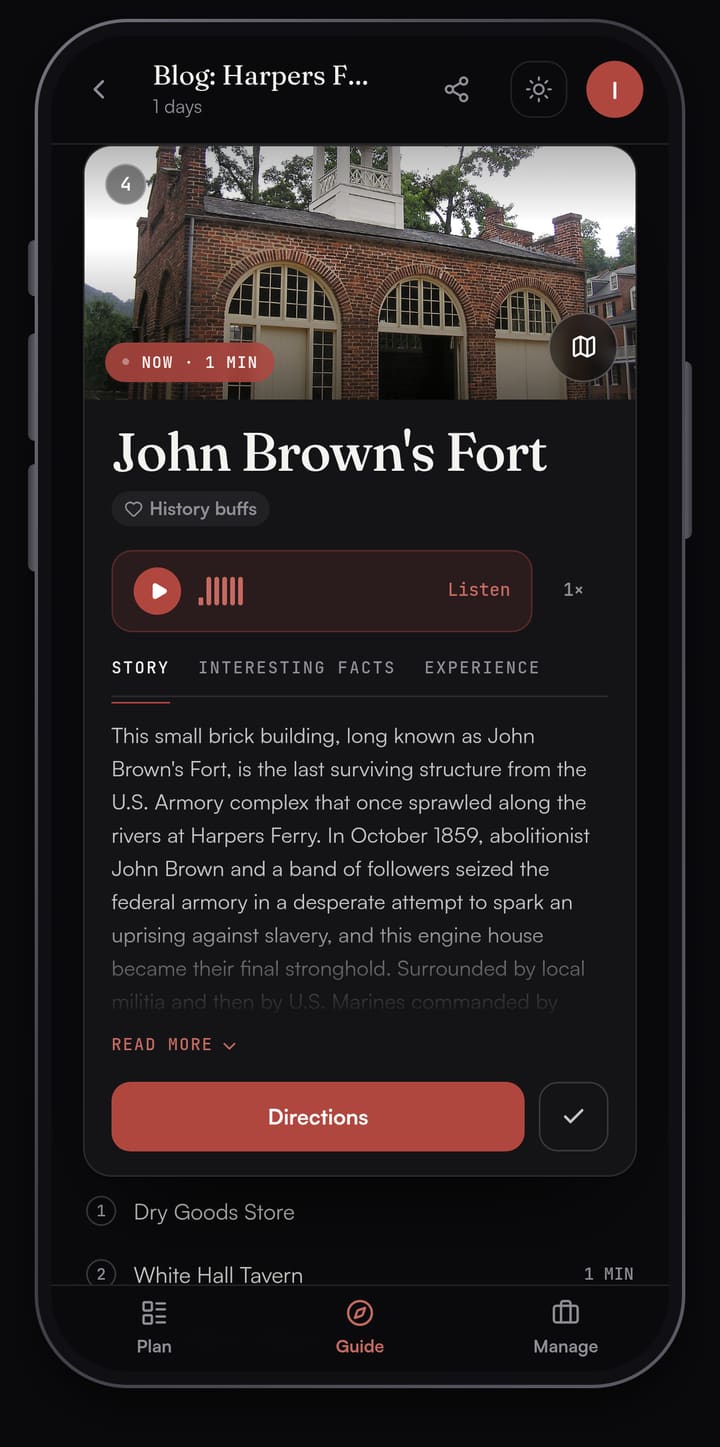
When you get to a stop, Passage AI's Guide opens a card like this with the story of the place. Tap Listen to hear it read aloud while you look at the building.
5. The Point, 12:05
Walk past the fort and up the short gravel path until you see the rivers. The Point is where the Potomac meets the Shenandoah, and from here you look into three states: Maryland, Virginia and West Virginia. In 1859 this corner was busy with the Wager House Hotel, a saloon, a restaurant and two railroad depots. Confederate troops blew up the B&O railroad bridge here on 14 June 1861, and the record flood of 1936 took out its successor (The Point).
Lunch break, 12:30
Take an hour. The NPS's own one-day plan tells visitors to bring water and snacks (plan like a park ranger), and the park has a picnic area next to the Visitor Center lot. There are also cafés and restaurants in town; opening days get shorter in winter, so check before you go.
6. St. Peter's Catholic Church and the 1810 stone steps, 1:15
The climb starts on High Street, at the stone steps between the African American History Museum and Civil War Museum buildings (both closed for repairs for now). At the top of the first flight you pass St. Peter's Catholic Church (Jefferson Rock directions).
7. Jefferson Rock, 1:35
Carry on up the next set of steps and past the ruins of St. John's Episcopal Church. Thomas Jefferson stood at this spot on 25 October 1783 and wrote up the view of the two rivers cutting through the Blue Ridge in Notes on the State of Virginia, calling it "worth a voyage across the Atlantic." The rock itself is a pile of shale slabs. It's unstable, and climbing on it is prohibited. The NPS also notes the path isn't accessible for visitors with physical limitations (Jefferson Rock).
8. Lockwood House and the Storer College campus, 2:15
Above Jefferson Rock the trail forks. The right fork goes to the Harper Cemetery and Lockwood House, the birthplace of Storer College (Camp Hill trail). Lockwood House was built in 1848 for the armory's paymaster, served as a Civil War hospital in 1862 and as General Henry H. Lockwood's headquarters in 1863 (Lockwood House).
After the war, Nathan Brackett ran schools for formerly enslaved people from this house. It grew into Storer College, open to men and women of all races, and it taught more than 7,000 students over 88 years before closing in 1955 (Storer College). The Niagara Movement, the forerunner of the NAACP, held its first conference in the United States at Storer College (plan like a park ranger). Walk the old campus, then head back down to Lower Town by Washington Street or the town streets.
Back in Lower Town, 3:30 to 5:00
You have time before the exhibits close at 5:00 and the last shuttle at 5:30. Use it for the other open exhibits. The Storer College and the Niagara Movement exhibit in Lower Town picks up the Camp Hill story, and Allies for Freedom, the Provost Marshal's Office and Meriwether Lewis at Harpers Ferry are all open too. The Harpers Ferry Park Association bookshop has the park's passport stamps (things to do).
How Optimize ordered the day
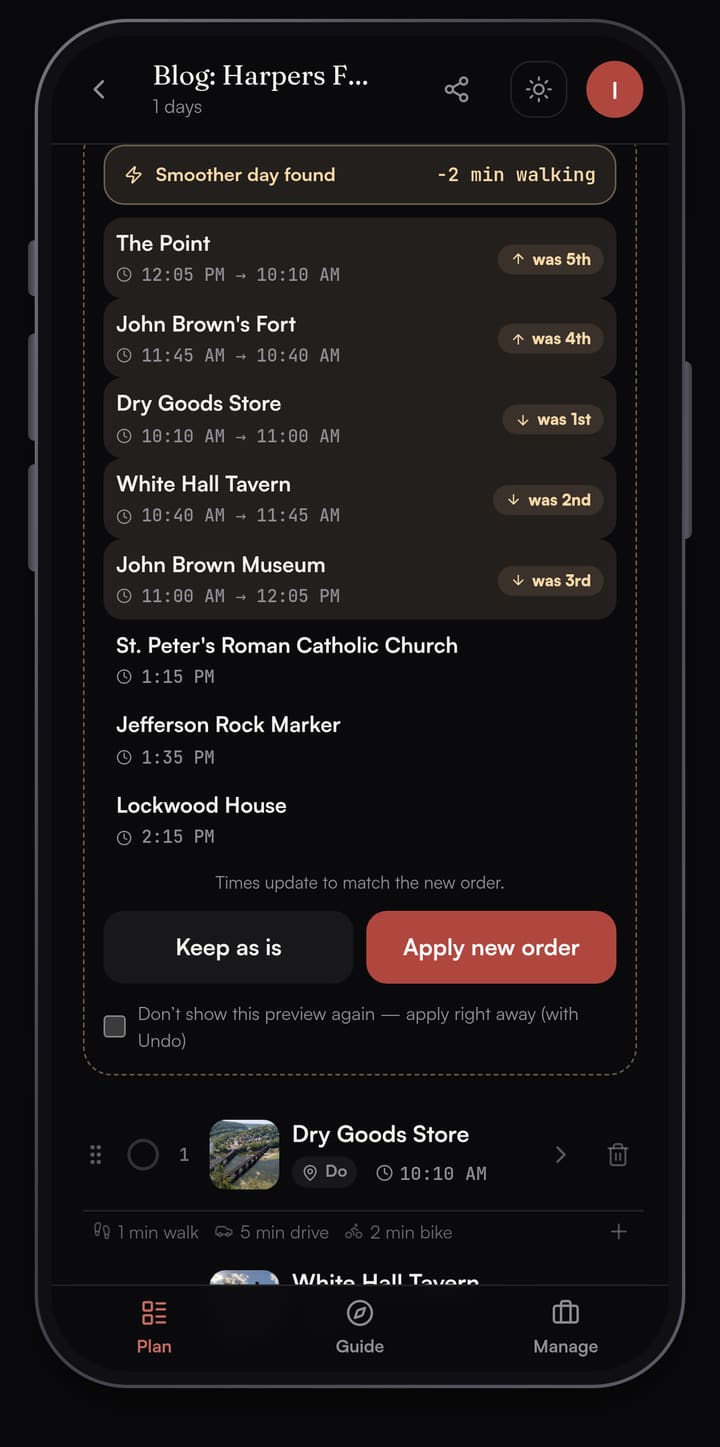
Optimize found an order with 2 minutes less walking: it starts at The Point and works back up Shenandoah Street to the shops. Both orders work. I kept the original one so the John Brown Museum comes before the fort, and you see the building after you know what happened in it. Tap Apply new order if you'd rather start at the rivers. Optimize shows the preview with each stop's old position first, and nothing changes until you press Apply.
What to book ahead in Harpers Ferry
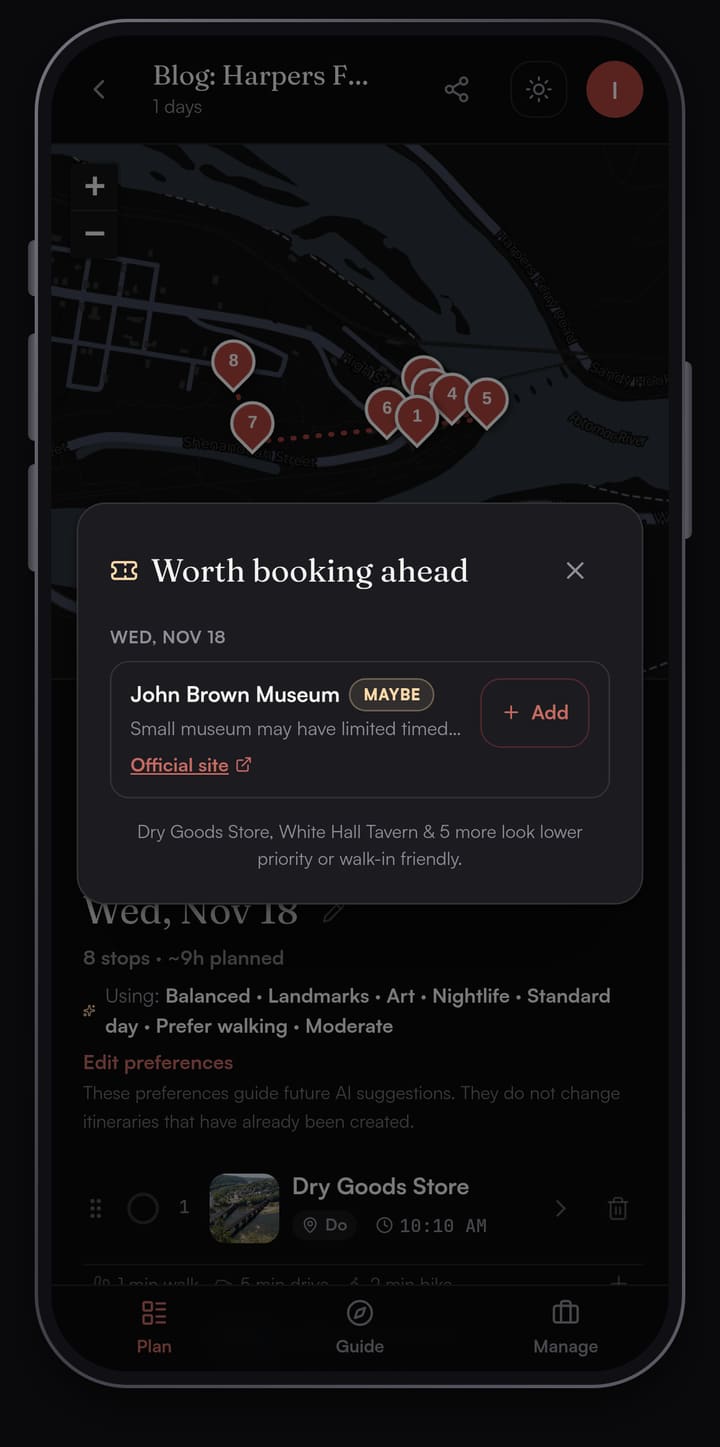
Need tickets? scans the whole trip and marks the stops that usually need booking, with a link to the official site. For this day it marked one stop as a maybe and the other seven as lower priority or walk-in friendly.
| Stop | App said | Official site says (Nov 2026) | My call |
|---|---|---|---|
| John Brown Museum | Maybe | Open 9:00 to 5:00 daily; museums included in the entrance pass | Walk in with your pass |
| Other seven stops | Walk-in | Exhibits included in the pass; The Point, the steps and Camp Hill are outdoor sites | Nothing to book |
The one thing to buy ahead is the park entrance pass itself. You can buy it online before you go, which saves the stop at the entrance station, and the park takes no cash.
What to skip or swap
- Pick your date around the closed days. The park closes on Thanksgiving Day (26 November 2026), 25 December and 1 January. Every other day, the Lower Town exhibits keep the same 9:00 to 5:00 hours.
- Four buildings are closed for repairs. As of the NPS conditions page, the Master Armorer's Quarters, Black Voices: African American History, the Civil War Museum and Harper House are closed. Everything else on this route is open. Check current conditions the week you go.
- The Potomac footbridge to Maryland Heights is closed. The Goodloe Byron Memorial Footbridge, the walkway across the Potomac to the Maryland Heights Trail and the C&O Canal towpath, is closed for safety repairs to its deck, and the NPS expects the closure to last through the fall. Leave the Maryland Heights hike for another trip.
- Steps are hard on your knees? Skip Camp Hill and stay in Lower Town for the afternoon. The NPS lists the Camp Hill loop at up to 1.8 miles round trip with up to 216 feet of climb, and the path to Jefferson Rock isn't accessible for visitors with physical limitations (Camp Hill trail).
- Want more walking? Past Lockwood House, the Appalachian Trail meets the old Cliff Trail, which drops steeply back down to Shenandoah Street. Cross over and follow the trail through the water-powered mill ruins on Virginius Island before the last shuttle (Camp Hill trail).
- Got a car and a second day? Your pass is good for three days. The NPS's own one-day plan adds the Civil War battlefields at Bolivar Heights, Schoolhouse Ridge and Murphy-Chambers Farm, sites of the 1862 Battle of Harpers Ferry (the town changed hands eight times during the Civil War). Murphy-Chambers Farm is a walk from the Visitor Center lot.
FAQ
Can you see Harpers Ferry in one day on foot?
Yes. Lower Town is compact, and the John Brown sites, The Point, Jefferson Rock and the Storer College campus all fit in one day between the first shuttle at 9:00 and the last one back at 5:30 in winter. Leave the longer hikes, such as Maryland Heights and Loudoun Heights, for another day.
How much does it cost to visit Harpers Ferry?
The NPS entrance pass is $20 per private vehicle, $15 per motorcycle, or $10 per person on foot or by bike (under 16s free). It lasts three consecutive days and covers parking at the Visitor Center, the shuttle, the museums and exhibits, and ranger programs. The park is cashless.
Where do you park for Lower Town Harpers Ferry?
At the Visitor Center lot, 171 Shoreline Drive, and take the shuttle down. The NPS says the Lower Town lots are often full, and paying for the town's metered street parking doesn't cover the park entrance fee.
What time does the last shuttle leave Lower Town?
From 2 November 2026 to 14 March 2027 the last bus leaves Lower Town at 5:30 p.m. From March it runs until 7:00 p.m. Buses run every 10 to 15 minutes, every day the park is open.
How hard is the walk up to Jefferson Rock?
It's a climb on historic stone steps and a trail, part of the Camp Hill loop that the NPS rates moderate (up to 1.8 miles round trip and 216 feet of climb, 45 minutes to 1.1 hours). The NPS says the Jefferson Rock path isn't accessible for visitors with physical limitations.
How this was made: planned in Passage AI on 2 November 2026, facts checked against the Harpers Ferry National Historical Park pages on nps.gov (hours, fees, getting around, parking, current conditions, things to do, and the history pages for each stop), written by Edward.
Cover photo: Harpers Ferry NHP (NPS Photo, Zurbuch) on Wikimedia Commons (CC BY 2.0, cropped)


