Takayama old town walking route: one day on foot, stop by stop
This Takayama old town walking route runs south to north through Takayama, in the Hida region of Gifu Prefecture, Japan. It starts at a temple five minutes from the station and ends at the hall that keeps the festival floats. Seven stops, all on foot: Hida Kokubunji, Takayama Jinya, the Miyagawa morning market, the Sanmachi merchant streets, the Showa-kan museum, the Kusakabe house and the Festival Floats Exhibition Hall. The walks between them add up to about 31 minutes, and no leg is longer than 7.
I built the day in Passage AI in October 2026 for a Wednesday. I added the seven stops, set the times and ran the Need tickets? scan. Every hour and price below is checked against Hida Takayama, the tourism site run by Takayama City.
Last checked: Oct 2026. Prices and hours change, and several stops switch to shorter winter hours from November or December. Open the linked official page before you go.
The Takayama old town walking route at a glance
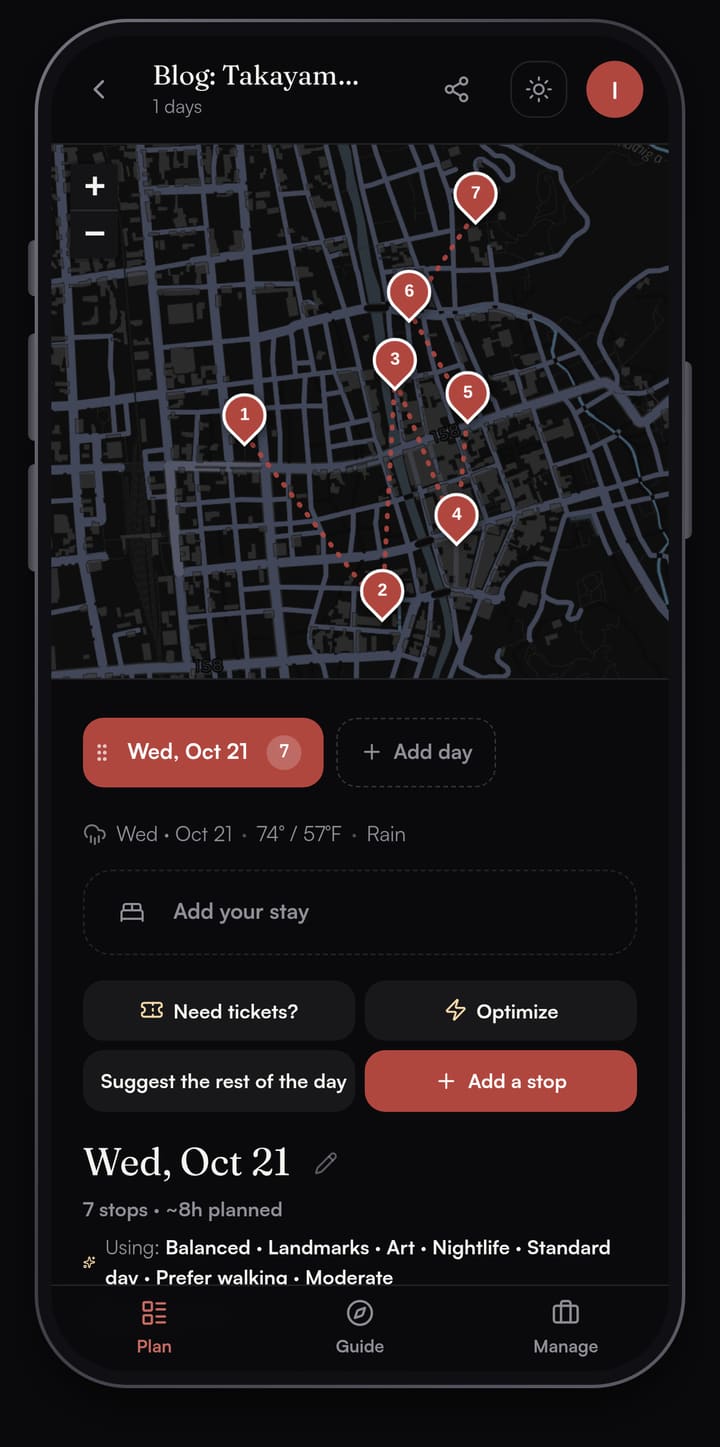
The table gives the day in order, with a time for each stop and the walking minutes to the next one.
| # | Stop | Time | Walk to next stop |
|---|---|---|---|
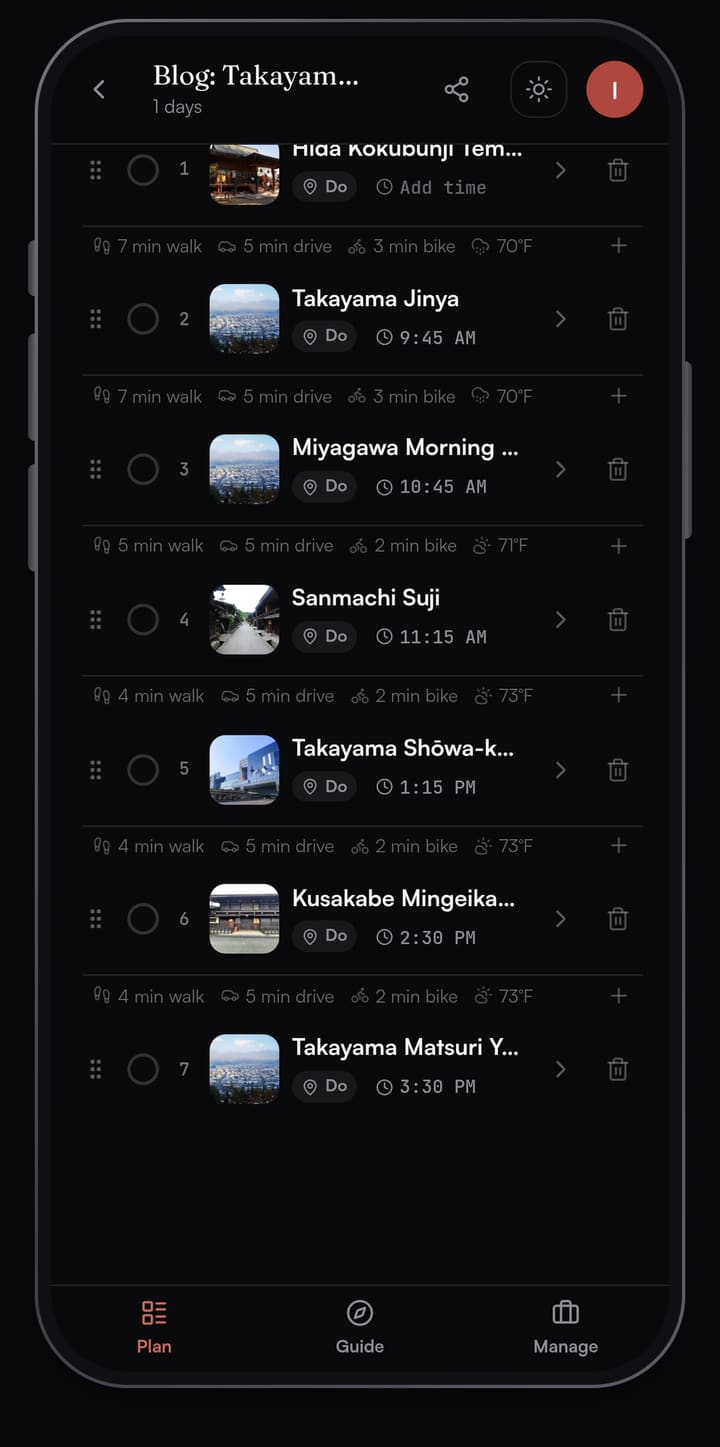
| 1 | Hida Kokubunji Temple | 9:00 | 7 min |
| 2 | Takayama Jinya and the Jinya-mae market | 9:45 | 7 min |
| 3 | Miyagawa Morning Market | 10:45 | 5 min |
| 4 | Sanmachi streets, then lunch | 11:15 | 4 min |
| 5 | Takayama Showa-kan Museum | 13:15 | 4 min |
| 6 | Kusakabe Folk Museum | 14:30 | 4 min |
| 7 | Takayama Festival Floats Exhibition Hall | 15:30 |
Walk times in Passage AI are straight-line estimates between stops at walking pace. Tap Directions and your phone's maps app opens with the street route. Entry tickets for the five paid stops come to 2,930 yen per adult.
Stop by stop
1. Hida Kokubunji Temple, 9:00
Start five minutes from JR Takayama Station, at Hida Kokubunji, which the city calls Hida's greatest ancient temple. The city's page lists a ginkgo tree over 1,200 years old, a three-storey pagoda and a main hall from the Muromachi period, about 500 years old, which makes it the oldest building in the city. The bell tower gate is said to have come from Takayama Castle. Opening hours are 9:00 to 16:00 and admission is 300 yen. The temple is closed on irregular days, so check before you go. (official page)
The temple sits closest to the station and opens at 9:00, so it goes first.
2. Takayama Jinya, 9:45
This was the office of the local governor in the Edo period. Japan once had more than 60 buildings like it, and Takayama Jinya is the only one left. It was in official use from 1692 to 1969, for trials, tax collection and storing the rice paid as tax. Hida mattered to the shogunate for its timber and its gold, silver, copper and lead, so the area was ruled directly.
From March to October it's open 8:45 to 17:00 (to 18:00 in August). From November to February it's 8:45 to 16:30. It closes on 29 and 31 December and 1 January. Admission is 430 yen for adults and free for high school students and younger. (official page)
The Jinya-mae morning market sets up on the square in front of the gate. The city says it started more than 300 years ago, when silk farmers came to sell mulberry leaves, and only farmers may run stalls today: vegetables, pickles, dried food. (official page)
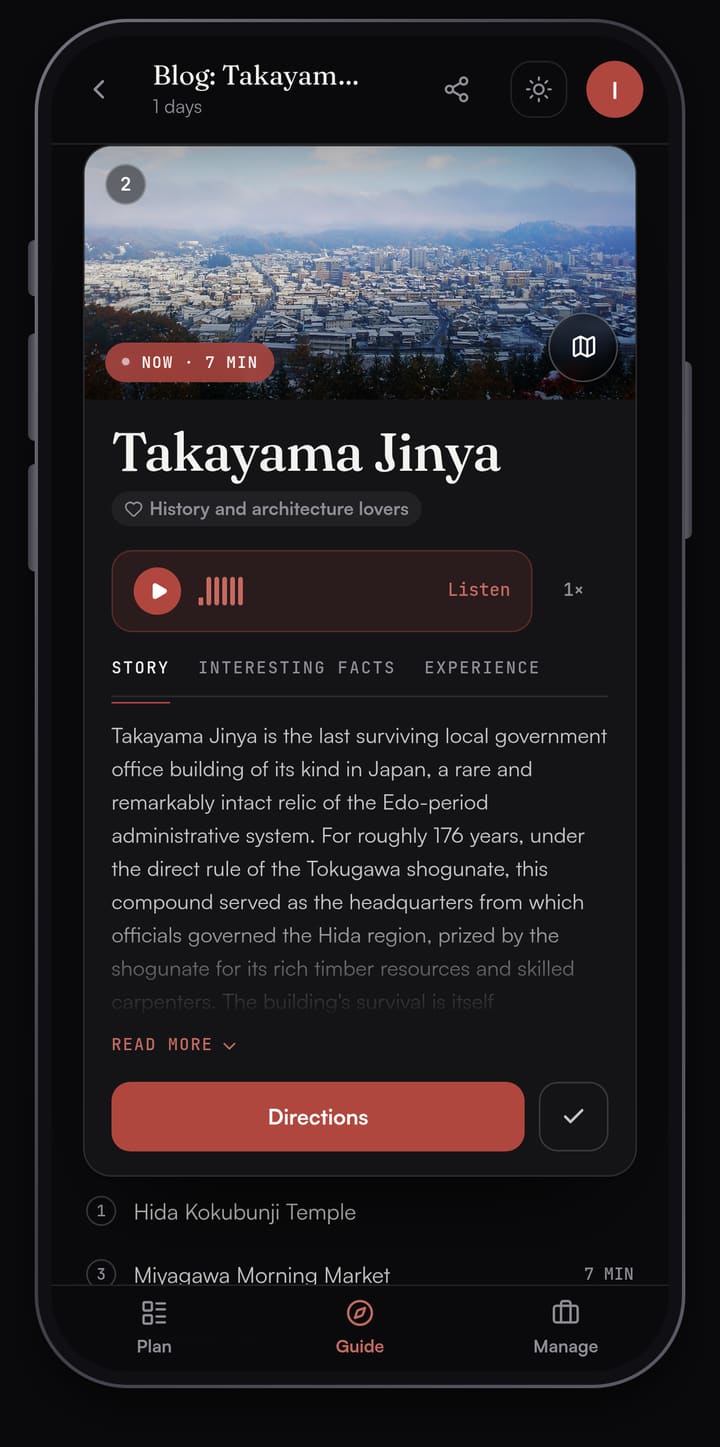
When you reach a stop, Passage AI's Guide opens a card like this with the story of the place. Tap Listen to hear it read aloud while you walk the rooms.
3. Miyagawa Morning Market, 10:45
The riverside market: about 60 shops and stalls along roughly 350 metres of the Miyagawa river, from Kajibashi bridge to Yayoibashi bridge. Stalls on the river side sell vegetables, fruit, pickles and spices. Shops on the other side sell Japanese sweets, crafts and Takayama souvenirs such as sarubobo dolls and Ichii Itto-bori wood carvings. From April to November both markets run 7:00 to noon, and from December to March 8:00 to noon. Entry is free. The city notes that the number of stalls can drop to about 10 in rain or in winter. (official page)
Both markets close around noon, so this is the last point in the day to catch them. If you're staying overnight in Takayama, the city suggests coming at the start, when farmers set up.
4. Sanmachi Traditional Buildings Preservation Area, 11:15
This is the old merchant quarter: streets of wooden townhouses with continuous latticework and water channels running under the eaves. Sake breweries hang a ball of cedar leaves over the door. The protected area covers parts of Kamiichinomachi, Kamininomachi and Kamisannomachi. The streets are public, so there are no hours and no ticket. (official page)
The city's page also points to the eateries and souvenir shops along these streets, so take lunch here. I left lunch open in the plan rather than naming a restaurant; give yourself until about 13:00.
5. Takayama Showa-kan Museum, 13:15
A museum that rebuilds a street from around 1950 indoors: a sweet shop at the entrance, a barbershop, a photo studio and a general store, all filled with objects from the period. It's open 9:00 to 18:00 every day of the year. Admission is 800 yen for adults. (official page)
6. Kusakabe Folk Museum, 14:30
A merchant house built in 1879, with low, deep eaves made for snow country and a large earthen-floored hall under heavy beams. It was the first merchant house in Japan to be named a National Important Cultural Property, together with Yoshijima House next door. From March to November it's open 9:00 to 16:30, and from December to February 9:00 to 16:00. In those winter months it closes on Tuesdays. Admission is 500 yen for adults. (official page)
The 16:30 close is why Kusakabe comes before the floats hall, which stays open later.
7. Takayama Festival Floats Exhibition Hall, 15:30
The hall stands in the grounds of Sakurayama Hachiman shrine and keeps the floats of the autumn Takayama festival. There are 11, and four are on display at a time. The display changes three times a year, in March, July and November. A shrine maiden guides visitors through. It's open daily, 9:00 to 17:00 from March to November and 9:00 to 16:30 from December to February. Admission is 900 yen for adults. (official page)
From here it's about a 20-minute walk back to the station, per the city's page.
What to book ahead in Takayama
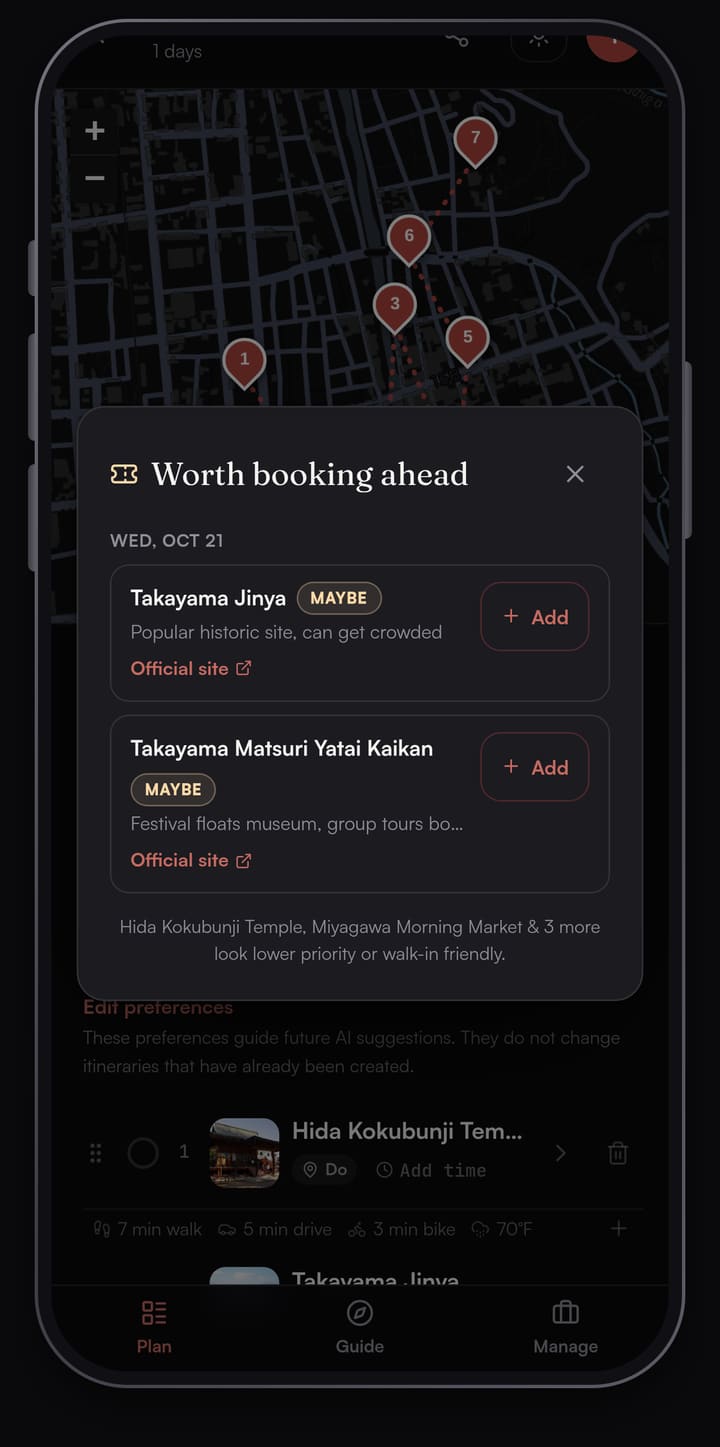
Need tickets? scans the whole trip and marks stops that may need booking, with a link to each official site. For this day it marked two stops as Maybe and listed the other five as lower priority or walk-in:
| Stop | Need tickets? | City site says (Oct 2026) | My call |
|---|---|---|---|
| Takayama Jinya | Maybe: popular, can get crowded | 430 yen; group rate for 30 or more | Walk up; go early |
| Festival Floats Exhibition Hall | Maybe: group tours book ahead | 900 yen; group rate for 20 or more | Walk up, unless you're a group |
| Hida Kokubunji, the markets, Sanmachi, Showa-kan, Kusakabe | Lower priority or walk-in | Admission listed, or free | Nothing to book |
That matches the city's pages, which list prices and group rates but no advance booking for individual visitors. None of the city's pages for these stops mention timed entry, so the plan can stay loose until the morning.
What to skip or swap
- Short on time? Skip the Showa-kan. At 800 yen it's the most expensive museum after the floats hall, and it covers the 1950s rather than the merchant town. Sanmachi and Kusakabe show the older Takayama.
- Want the thatched farmhouses? Hida Folk Village (Hida-no-Sato) has more than 30 old buildings, including thatched-roof houses, recreating Hida's farming villages. It's outside the walking core: the city's page gives a 10-minute ride on the Sarubobo Bus from the Nohi Bus Center to the Hida-no Sato-Shita stop, 210 yen each way. It's open 8:30 to 17:00 all year and costs 700 yen. Give it half a day of its own. (official page)
- Coming in winter? From December, Kusakabe closes at 16:00 and on Tuesdays, the floats hall closes at 16:30, Takayama Jinya closes at 16:30 (from November) and the markets open at 8:00. Move the afternoon stops half an hour earlier and avoid Tuesdays.
- Coming in August? Takayama Jinya stays open to 18:00, so you can move it to the end of the day and start at the markets.
FAQ
Can you see Takayama's old town in one day on foot?
Yes. Every stop on this route is listed by the city as 5 to 20 minutes' walk from JR Takayama Station, and the old town is compact. Seven stops with lunch fit between 9:00 and 17:00. Hida Folk Village is the exception: it's a bus ride away and needs its own half day.
What time do the Takayama morning markets open?
From April to November both markets, at Miyagawa river and in front of Takayama Jinya, run 7:00 to noon. From December to March they run 8:00 to noon. They're open all year and free to walk through.
How much do the entry tickets on this walk cost?
For one adult: Hida Kokubunji 300 yen, Takayama Jinya 430 yen, Takayama Showa-kan 800 yen, Kusakabe Folk Museum 500 yen and the Festival Floats Exhibition Hall 900 yen. That's 2,930 yen. The markets and the Sanmachi streets are free.
What day of the week is best for this route?
From March to November any day works: the city lists no weekly closing day for these stops. Hida Kokubunji closes on irregular days, so check before you go. From December to February avoid Tuesdays, when Kusakabe is closed.
Do you need to book anything in advance?
The city's pages give an admission price for each paid stop and mention no advance booking for any of them. The planning here is about timing: the markets end at noon and Kusakabe closes at 16:30.
How this was made: planned in Passage AI on 20 October 2026, facts checked against the Takayama City tourism site (hida.jp), written by Edward.
Cover photo: DimiTalen on Wikimedia Commons (CC0 1.0, cropped)
